
Amos 1:1
The words of Amos, who was among the shepherds of Tekoa, which he saw concerning Israel in the days of Uzziah king of Judah and in the days of Jeroboam the son of Joash, king of Israel, two years before the earthquake.
The kingdom years of ancient Israel covered over 500 years of tumult. The events covered by Samuel, Kings, and Chronicles in the Bible often read like they could have happened during medieval times. We learn about some of history’s greatest heroes and worst villains. There are accounts of power and foolishness, intrigue and betrayal, and wisdom and faithfulness. Through all of these accounts, the world revolves around the kings and queens. The good and wise leaders lead their people through peace and prosperity, while the foolish and wicked rulers lead the people into wickedness and chaos.
The people of Israel had existed as a confederacy of twelve tribes until uniting in their wish for a king. God directed the prophet Samuel to their first king, Saul, in about 1100 B.C. Saul failed to obey God, and so the kingdom passed to David, a young shepherd from Bethlehem. David’s reign brought a golden age to Israel’s history, giving the nation expanded borders, peace from war, and, through David’s son Solomon, unequaled prosperity. At the height of Solomon’s kingdom, the nation of Israel stretched from the Mt. Hermon in the north to Sinai in the south, from the Mediterranean in the west, to the Ammonite and Syrian territory in the east. All neighboring nations were either allied or subdued by Israel during David’s and Solomon’s reigns.
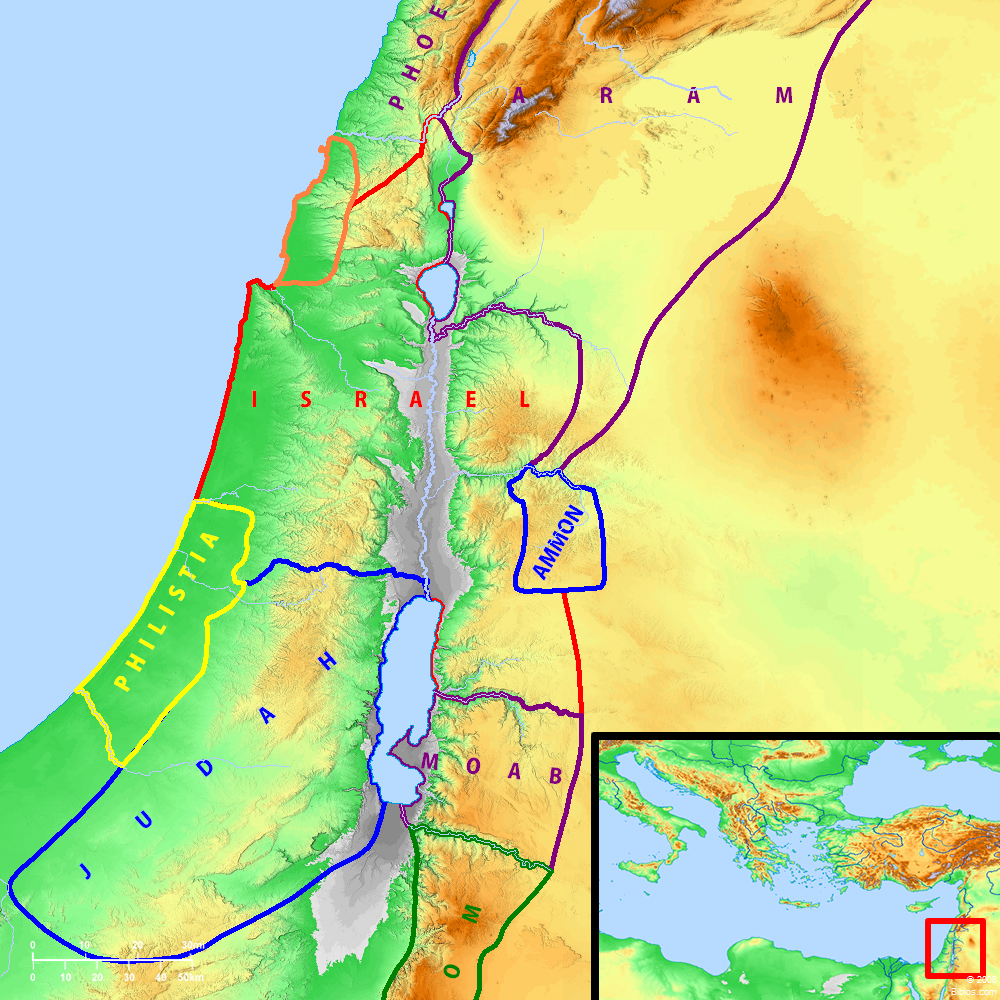
Despite all of David and Solomon’s success, it took only one foolish act by Solomon’s son, Rehoboam, to shatter the united kingdom. As Rehoboam came to power in about 950 B.C., the northern tribes sent a delegation asking him to ease their pressure. Instead of granting their request, Rehoboam chose instead to stamp his authority and force them to submit. Jeroboam, who had led the northern delegates, now led them in breaking away from David’s dynasty, forming a separate kingdom. From that time on, the people of Israel were divided into two nations: the kingdom of Judah in the South, consisting of the two faithful tribes to David’s family (Judah and Benjamin), and the kingdom of Israel in the North, consisting of the remaining ten tribes.
One of Jeroboam’s first acts as king of Israel was to move the center of worship. The temple of God was in Jerusalem, where the people would regularly go to celebrate and offer sacrifices. But Jerusalem was also the capital city of Judah, Jeroboam’s rival nation. Therefore, he built two worship centers in the northern city of Dan and in the southern city of Bethel. Instead of directing the people to worship The Lord, he had two golden idols (of calves) built for worship. Jeroboam’s decision may have been politically astute, but he directly violated God’s laws by building idols and moving the people from true worship. These golden idols would be a stumbling block throughout the entire history of the northern kingdom.
The books of Kings and Chronicles tell about the succession of rulers over these two kingdoms. The descendants of David ruled over Judah in the South, with a (roughly) even split between good and wicked kings.a b The northern kingdom of Israel was much less stable. None of the kings followed God, and there was only one dynasty that lasted for more than three generations.
A detailed chart showing the timeline of the kings and the prophets is available here: https://www.biblegateway.com/blog/2017/07/updated-chart-of-israels-and-judahs-kings-and-prophets/
The Lord sent prophets to His disobedient people in order to bring them back to Him. He sent “speaking prophets”, such as Elijah and Elisha, to boldly preach His word with power and authority. But then, starting in the 8th century B.C., came the “writing prophets”. Not only did these men preach to the people, but they wrote down God’s message. Through the next 400 years, these men were faithful to write down God’s Word and to record their warnings to the people. Tradition has divided their messages into two groups: the four major prophets, containing the writings of Isaiah, Jeremiah, Ezekiel, and Daniel, and the twelve minor prophets, containing the writings of Hosea through Malachi.c The prophets were not divided based on their importance or their stature, but by the size and scope of their message. The major prophets contained much larger writings and tended to cover a very broad scope of prophecy, while the minor prophets tended to have much shorter works, covering (usually) a much smaller scope. For example, contrast the 66 chapters of Isaiah to the single chapter of Obadiah!
It is my goal during the next few studies to look into the message of Amos, one of the lesser-known prophets.
 Sapphire Sky