What a uniting presidential address sounds like …
Category: politics, economy, etc.
As previously noted, on May 8th, voters in North Carolina will decide whether to add to the State’s constitution a provisions that provides:
“Marriage between one man and one woman is the only domestic legal union that shall be valid or recognized in this State. This section does not prohibit a private party from entering into contracts with another private party; nor does this section prohibit courts from adjudicating the rights of private parties pursuant to such contracts.”
Opponents claim that the proposed Amendment ultimately could deny domestic violence protections, child custody and visitation rights, and other legal benefits to thousands of unmarried couples in NC. Their concerns are based on a legal analysis of the Amendment published by Maxine Eichner, a law professor at UNC School of Law and a leading academic on feminist and queer legal theory.
Campbell law professors Lynn Buzzard, William Woodruff, and Gregory Wallace have published a detailed reply to Eichner disputing the accuracy of her legal analysis and rejecting her stated concerns regarding how the Amendment might harm unmarried couples. The Campbell professors’ purpose is to advance the public dialogue by addressing the flawed analysis of Eichner, whose misleading claims have provided the basis for the opposition’s ongoing scare campaign. The professors explain,
The reason for this paper is a narrow one. We do not endorse or oppose the proposed Amendment. There are thoughtful arguments on both sides, and we encourage a robust public debate about the Amendment. Our aim instead is to help clarify for North Carolina voters the Amendment’s legal meaning and likely effects. We believe that the Amendment debate has been distorted by concerns over certain legal consequences that are highly unlikely to occur. … We emphasize again that it is not up to us to tell anyone how to vote on the proposed Amendment. We offer this paper only as a modest attempt to explain the meaning and likely effects of the Amendment, should it pass. We believe that North Carolina voters are best served by having accurate legal information about the Amendment, so that they can properly consider the Amendment’s pros and cons and then vote their conscience.
The Campbell Law professors conclude that even if the Amendment passes, unmarried and same-sex couples still will be protected under domestic violence laws, would retain their current rights to child custody and visitation, and could continue to received public health insurance benefits.
The three professors state that because the Amendment applies to “legal unions” and not “relationships,” it bars only same-sex marriage and legal recognition of civil unions and domestic partnerships that resemble marriage unions. The flaw in Eichner’s arguments is that she does not give the term “legal union” its proper legal effect in construing the Amendment. (Eichner admitted to me in debate that even without the “domestic legal union” clause, she still would not support a prohibition against same-sex marriage.)
The law professors’ full, detailed analysis can be found here: The Meaning and Potential Legal Effects of North Carolina’s Proposed Marriage Amendment
The North Carolina Marriage Amendment is modeled after Idaho’s, as shown below. As shown below, the North Carolina Amendment is less restrictive than Virginia’s, effectively the same as South Carolina’s and more restrictive than Tennessee’s. In my opinion, the North Carolina Amendment is the most clear and concise as compared to our surrounding States.
North Carolina the Marriage Amendment:
Marriage between one man and one woman is the only domestic legal union that shall be valid or recognized in this State. This section does not prohibit a private party from entering into contracts with another private party; nor does this section prohibit courts from adjudicating the rights of private parties pursuant to such contracts.
Idaho Amendment (2006):
A marriage between a man and a woman is the only domestic legal union that shall be valid or recognized in this state.
[Unlike the NC version, Idaho does not expressly protect private contracts pertaining to domestic relations between same sex adults]
Virginia Amendment (2007):
Only a union between one man and one woman may be a marriage valid in or recognized by this Commonwealth and its political subdivisions. This Commonwealth and its political subdivisions shall not create or recognize a legal status for relationships of unmarried individuals that intends to approximate the design, qualities, significance, or effects of marriage. Nor shall this Commonwealth or its political subdivisions create or recognize another union, partnership, or other legal status to which is assigned the rights, benefits, obligations, qualities, or effects of marriage.
[prohibits same sex marriage, civil unions, and private contract]
South Carolina (2006):
This amendment provides that the institution of marriage in South Carolina consists only of the union between one man and one woman. No other domestic union is valid and legal. The State and its political subdivisions are prohibited from creating or recognizing any right or claim respecting any other domestic union, whatever it may be called, or from giving effect to any such right or benefit recognized in any other state or jurisdiction. However, this amendment also makes clear it does not impair rights or benefits extended by this State, or its political subdivisions not arising from other domestic unions, nor does the amendment prohibit private parties from entering into contracts or other legal instruments.
[prohibits same sex marriage and civil unions]
Tennessee (2006):
The historical institution and legal contract solemnizing the relationship of one man and one woman shall be the only legally recognized marital contract in this state. Any policy or law or judicial interpretation, purporting to define marriage as anything other than the historical institution and legal contract between one man and one woman is contrary to the public policy of this state and shall be void and unenforceable in Tennessee. If another state or foreign jurisdiction issues a license for persons to marry and if such marriage is prohibited in this state by the provisions of this section, then the marriage shall be void and unenforceable in this state.
[prohibits same sex marriage]
On May 8, 2012, North Carolinians will vote on whether to add the following language to the Constitution of North Carolina:
Marriage between one man and one woman is the only domestic legal union that shall be valid or recognized in this State. This section does not prohibit a private party from entering into contracts with another private party; nor does this section prohibit courts from adjudicating the rights of private parties pursuant to such contracts.
Meanings often change with times. The meaning of a word changes when people use it in a new and different way.
Gay. Fifty years ago, if I told you I was gay, it would mean something quite different than what it means to people today.
Word usage by people determines new meanings.
Marriage.
It’s a word. But it is also a civil, legal and religious institution. I support the NC Marriage Amendment because I believe the legal and civil purpose for the institution of marriage is to protect and encourage the lifelong commitment between one man and one woman to raise a family. Marriage is the institution designed for the creation and nurturing of children.
I will offer the following four points:
1. Some say that we do not need the Marriage Amendment because it already reflects the status of state and federal statutory law. However, I believe that the Marriage Amendment is necessary to ensure that marriage is defined by the people of North Carolina, and not by a handful of judges. As a Constitutional amendment, the people of North Carolina would directly control the meaning and purpose of this institution.
2. There are two views of marriage in this debate – the traditional view that the institution of marriage is the lifelong commitment between a man and a woman to create, sustain and raise a family. The competing view purposes the institution for adults to express and validate lifestyle choices. Some have characterized this debate as “child centric” versus “adult centric” views on marriage or whether the institution is tied to promoting procreation.
3. The law is normative. How you define the purpose for the institution of marriage has consequences. When the institution of marriage is no longer about a lifelong commitment to family and children – it stops functioning to produce commitment, family and children. Accordingly, the countries that have been progressively redefining marriage to be about adult preferences, marriage and reproduction rates are plummeting to dangerously low numbers. I find merit to the concerns expressed by some that the West is committing societal suicide by demographics.
4. The numerous and mutating objections about the Marriage Amendment causing harm to families, business and domestic violence protections are disingenuous and ignore what has happened in the 29 other states that have amended their constitutions to ban gay marriage. Critics have failed to put forward credible evidence of these threatened harms occurring in these numerous states over the past several years.
This brings us to the first issue with the Marriage Amendment –
I. Is the Marriage Amendment necessary?
YES. American’s have not redefined the word nor the institution of marriage. The effort to redefine marriage has been spearheaded by lawyers, the legal academic elite and a handful of judges.
Institutions and morals can change with times. When morals change, the law often changes to reflect the new values. But there’s no evidence the meaning of the word has changed through popular usage nor the institution.
The black letter dictionary on law – Black’s Law Dictionary defines marriage as the legal union of one man and one woman as husband and wife. The second edition of the Oxford American Dictionary is the most recent, comprehensive lexical analysis of American English. Completed in 2005, it defines marriage as the union between a man and a woman.
Similarly, our current statutes reflect the view that marriage is between a man and a woman. The federal Defense of Marriage Act, signed into law by President Clinton states that “’marriage” means only a legal union between one man and one woman as husband and wife …) 1 USC § 7. North Carolina General Statute § 51-1.2 establishes that same sex marriages are not valid in North Carolina.
However, the force for changing the definition of marriage to include gay marriage was a handful of judges and the power of their courts. Eight states recognize homosexual marriages – the first three States in our Republic to do so – were the result of judicial decree.
Massachusetts: May 17, 2004, Court Order
Connecticut: Nov. 12, 2008, Court Order
Iowa: April 24, 2009, Court Order
Vermont: Sept. 1, 2009, Legislation
New York: June 24, 2011, Legislation
New Hampshire: Jan. 1, 2010, Legislation
Washington: Feb. 14, 2012, Legislation
Maryland: passed Mar. 1, 2012; effective Jan. 1, 2013, Legislation
This issue of marriage should be resolved by the people of North Carolina and not by attorneys or judicial decree. Through the legislative process, only five states have adopted homosexual marriage. In contrast 29 states have expressly prohibited homosexual marriage by Constitutional Amendment, and one state has passed a constitutional amendment authorizing the legislature to ban gay marriage.
10 States w/amendments that ban same-sex marriage: Alaska, Nevada, Mississippi, Missouri, Montana, Oregon, Colorado, Tennessee, Arizona, California – whose ballot initiative banning gay marriage is presently enjoined by the 9th Circuit
18 States w/amendments that ban same-sex marriage & civil unions but not other contracts: Nebraska, Arkansas, Georgia, Kentucky, Louisiana, North Dakota, Ohio, Oklahoma, Utah, Kansas, Texas, Alabama, Idaho, South Carolina, South Dakota, Wisconsin, Florida
2 States w/amendments that ban same-sex marriage, civil unions & related contracts: Michigan, Virginia
The people, not a judge, should decide whether we want to redefine what marriage means in North Carolina. If the Marriage Amendment is passed by the voters, then under state law, it can only be changed by a vote of the people.
II. The traditional versus the radical feminists and critical legal theorist’s theory of marriage
What’s the purpose for the institution of marriage? Why do we have “marriage”?
Is marriage primarily about family or about the individual’s liberty of lifestyle?
How you answer this should largely inform your views on whether you think the institution of marriage ought to include homosexual partners.
A. The traditional definition of marriage.
In his 1828 American Dictionary of the English Language, Noah Webster defined marriage as follows:
The act of uniting a man and woman for life; wedlock; the legal union of a man and woman for life. Marriage is contract both civil and religious, by which the parties engage to live together in mutual affection and fidelity, till death shall separate them. Marriage was instituted by God himself for the purpose of preventing promiscuous intercourse of the sexes, for promoting domestic felicity, and for securing the maintenance and education of children.
Webster’s definition reflects the traditional, Judeo-Christian perspective on marriage. This is the definition to which the people of the Carolinas have regulated the legal institution for over 343 years, since the original royal charter of the Province of Carolina. It is the view held uniformly throughout the West for the past 2000 years, until about 20 years ago.
Under this traditional view, marriage is a life long commitment between a man and a woman and is the foundation of the family. The family is the foundation of society as it is the family that creates, nurtures and raises the next generation. In this view, marriage is a sacred bond between the man and woman, in the presence of the family, friends and before God. The family is the foundation of any and every society.
The traditional view on marriage is premised on the idea that marriage and raising children are hard work that requires a lifetime of largely selfless commitment. The institution of marriage is to encourage and protect that union and labor for the benefit of the children.
The traditional view of marriage is also premised on the idea that society should promote and protect children being raised by their biological mothers and fathers who are committed and legally obligated to the well being of the family. There is great and ancient wisdom in this sentiment that we should all recognize. There is an overwhelming common pathology in our prisons and on our welfare roles: children raised without their fathers. Every year about one million more children are born into fatherless families. If we have learned any policy lesson well over the past 35 years, it is that for children living in single-parent homes, the odds of living in poverty are great. The policy implications of the increase in out-of-wedlock births are staggering. Marriage drops the probability of poverty by 80%.
Decades upon decades and hundreds if not thousands of empirical studies repeatedly demonstrate that children raised in a home with their married mother and father are substantially more healthy, wealthy, happy, and productive than their counterparts who were not.
Under the traditional view of marriage and family – the self is subordinated to the good of the family, particularly to the good of the children. Through the traditional institution of marriage, adult society protects, promotes and encourages a child’s right to be raised in a secure environment by his or her biological parents. The traditional view of marriage is child focused.
B. The radical feminist and critical legal theorist’s view of marriage.
The moral and legal theory behind the gay marriage effort finds its genesis in radical feminist and queer legal theory[1], the scholars of which are not laudatory of the traditional institution of marriage.
The motto of the feminist legal theorists and sexual revolutionaries of the late 60s was “smash monogamy”. Marriage was portrayed as an institution of suppression. Now, a generation later, they are fighting for homosexuals to be admitted into the legalized institution of monogamy – marriage.
This isn’t irony. It’s intentional. It’s a deliberate and ongoing effort to redefine how society views and lives marriage. From this radical perspective, the primary purpose of the institution of marriage is to fulfill and validate the individual’s liberty of lifestyle, be it heterosexual, gay, lesbian, transgender, polygamous, or polyamorous. Same sex marriage repurposes marriage from a child-focused institution to an institution focused on validating and facilitating the expressive desires of adults.
Under this individual liberty view of marriage, marriage exists as an institution through which adults live and express themselves on the issues of family and sex.
This radical individualism and radical egalitarianism is not something new. In fact, it’s not even new to the institution of marriage. Starting in the 1970s, we began redefining marriage. Now if marriage doesn’t make you happy, end it. The no fault divorce – divorce rates since the 1980s have vacillated between 40 to 50%.
Instead of a lifelong commitment to the family, we began changing the institution of marriage into a perishable commodity. The institution is still focused on family and children, but only for so long as we feel like it.
The youth of today are the first generations raised in the culture of disposable marriage. It also shouldn’t be surprising then for us to find that a majority of these youth attach little moral, legal, or emotional significance to the institution of marriage being extended to gay adults who want to “enjoy” this celebration of individual liberty.
I respectfully suggest, and having lived through it personally can testify, that this concept of marriage as a disposable commodity is not at all healthy for children nor for the future of this Republic.
The proper view of marriage in a healthy society is that marriage is a life long union between a man and woman for purposes of raising a family together. Marriage should remain child focused.
The underlying issue pertaining to the Marriage Amendment is not about homosexuals raising children. It’s about the purpose of marriage: is it an institution to celebrate individual liberty, or is it a lifelong commitment between a husband and wife for the purpose of raising their children?
Marriage should not be an institution for validating sexual preferences. The institution of same sex marriage would change the institution of marriage from a child-focused institution to an adult-centered institution.
Deliberately conceiving a child with the life plan that he or she will never have a relationship with his or her father is unjust and cruel to the child. Sex is not an irrelevant category for parenting. All else being equal, children do better when there is both a mother and father in the home dedicated to raising them. Further, there is already a crisis of absentee fathers in this country.
The West has led the world in redefining marriage to be about individual liberty interests. There has been a pronounced and undeniable impact, and it has not been family or child friendly.
III. There are serious consequences to redefining marriage to be about the wants and needs of adults.
When marriage stops being primarily about commitment to and raising a family, then marriage stops producing commitment and family.
We talk a lot about the importance of education for equipping the next generation for tomorrow. But there is a more important, a more fundamental imperative for our children’s future: the future first belongs to those that show up. Our Western liberal democracies are showing an ever fading interest in showing up for tomorrow. To the contrary, there is compelling evidence that we are in a demographic death spiral, particularly in Europe, which spiral appears to have started with our redefining the institution of marriage to be about the wants and needs of adults instead of the creation and sustenance of families, i.e. children.
The family in the West is crumbling and our reproductive rates are plummeting.
1. Netherlands in 2001 legalized gay marriage – the public debate there and lawsuits started in earnest in 1989. I was there in 1990. A funny thing happened. Starting in the 1990s, the institution of marriage began to crumble. In 1995, 15% of births were out of wedlock. By 2009, out of wedlock births increased to 41% of births;– fertility rate of 1.78 children per couple. A healthy country requires a fertility rate of 2.1 to sustain its population;
You cannot prove causality – however, free and open sexual expression and treating marriage as a validation of lifestyle choices has not produced more families or more children. The opposite has happened.
The law is normative. It counsels what is acceptable conduct. Gay marriage is about validating the liberty of lifestyle choices. When the institution of marriage is no longer about commitment, family and children – it stops functioning to produce commitment, family and children.
2. Belgium legalized homosexual marriage in 2003 – from 1995 to 2009, out of wedlock births increased from 18% to 42% of births out of wedlock; fertility rate of 1.65
3. Spain legalized homosexual marriage in 2005 – from 1995 to 2009 – out of wedlock births increased from 10% to 32%; fertility rate of 1.48
United States – we presently have a fertility rate of 2.06; our births out of wedlock were 41% in 2008 according to the CDC. Within that, for Asian’s the rate is 17% of births out of wedlock, 28% for whites, 52% for Hispanics, and 72% for blacks. Marriage and procreation are already under great duress in this country. The collapse of the institution in the United States coincides with the advent of the “no fault” divorce here. Making the institution of marriage even more adult and expressive centric will likely only lead to what we see in Europe – a collapsed institution and unsustainable level of procreation.
Procreation is the most fundamental function of a healthy society.
How do these fertility rates compare with countries that have not followed the lead to make marriage about adult expression? You need 2.1 fertility rate to sustain.
Brazil has a fertility rate of 2.2.
Mexico has a fertility rate of 2.5
India – 2.58 fertility rate
Egypt – 2.94 fertility rate
Pakistan – fertility rate 3.52
The nations that have openly and aggressively redefined marriage to be adult focused are perhaps not surprisingly, not having children. Examining the countries that have led the way on gay marriage, we find fertility rates from 1.48 to 1.78. That’s not family friendly.
To the contrary, the West is in a demographic death spiral. This will result in declining and aging populations; changed social relations, economic pressure from shrinking populations; and if given large immigration patterns with disproportionately higher birth rates persist (which is the case in Europe with robust fertility rates within the immigrant Muslim demographic) – we will have entirely changed cultures/societies within a few generations.
When the institution of marriage ceases to be about children, sustainable reproduction dies and you have a dying country.
The institution of the family is in duress across the very Western liberal democracies that have taken it upon themselves to redefine the purpose of marriage. We should not redefine the institution further. Marriage should be about the life long commitment of a man and a woman for the purposes of raising their biological children.
IV. Subterfuge Arguments
There have been numerous allegations that this Amendment would have countless unanticipated ramifications that would hurt children and families.
Most of these claims lack merit.
1. The Amendment cannot be both unnecessary and too dangerous? On the one hand, critics claim the Amendment is unnecessary because it doesn’t change the current status of the law. On the other hand, we’re told that the Amendment will harm heterosexual couples. If the amendment does not change the legal status quo, it should have no affect the day after enacted. The only difference the day after enactment is that the people of North Carolina will control the definition of marriage in North Carolina.
2. What’s the motive? This debate is not about the wording of the Amendment. The people raising these arguments do not want to fix imprecise wording. The wording is not imprecise. The people making these arguments object to the traditional notion of marriage being the institution through which one man and one woman raises a family. They object to the fundamental moral dispute. Not the wording of how it is enacted. They do not support a more carefully worded restriction.
3. We’re not the first. We’re looking at being the 31st State to pass a constitutional amendment limiting marriage to one man and one woman. The critics’ unintended consequences arguments might be more persuasive if we were the first state to pass such an Amendment. Or maybe if we were the second, third or even fourth state. We’re not. This Amendment was based on studying the 30 current amendments already on the books and enforced in other states. This is a well-worn path. From the 30 prior iterations, the critics have not produced any meaningful evidence of these harms. Our Amendment is nearly identical to Idaho’s amendment, which was passed in 2006. Critics cannot point to one adverse resulting event there. Our Amendment is far less restrictive than Virginia’s, yet again, there is not one example of harm there. Despite amendments in dozens of states for many years, there is no pattern or evidence of adverse, unintended consequences. Critics claims to the contrary are unsubstantiated.
4. Based on a 2011 report by the American Legislative Exchange Council, the Marriage Amendment should not adversely affect North Carolina’s economy. A 2011 report by the American Legislative Exchange Council ranked states by economic performance between 1999 and 2009 and by economic outlook. Eight of the top ten economically performing states have amendments banning homosexual marriage. None have legalized same-sex marriage, civil unions or domestic partnerships. Nine of the 10 states forecasted to have the poorest economic growth have legalized same-sex marriage, civil unions and/or domestic partnerships.
5. The amendment should not affect the enforcement of domestic violence laws. This is perhaps the most spurious of arguments. Out of 30 states having already amended their constitutions, the opponents rely upon an instance in Ohio where a trial court refused to enforce a domestic violence statute based on the Ohio Marriage Amendment. What the critics don’t tell you is that the trial court was reversed by the Ohio State Supreme Court in 2007. The critics rely upon a reversed decision that has nothing to do with North Carolina’s domestic violence statutes. For lawyers, the trial court’s decision is called bad precedent. See Ohio v. Carswell, 871 N.E.2d 547 (Ohio 2007)
6. The amendment will not nullify medical powers of attorney (MPOAs) wills and trusts if the parties are homosexual partners. Under G.S. 32A-18 “any competent person who is not engaged in providing health care to the principal for remuneration, and who is 18 years of age or older, may act as a health care agent.” The relationship between the patient and the designated agent does not matter. The intent of the testator and trustor is the “gold standard” in N.C. for interpreting wills and trusts. The amendment does not change the intent of the testator in either type of these instruments. The amendment explicitly states that it will not affect the rights of parties to enter into private contractual agreements.
7. The Marriage Amendment will not determine the custody and visitation rights of unmarried parents unless their behavior affects the child. Custody orders are based on the parent/child relationship, not on the domestic relationship between the parents. Courts have based custody and visitation on the “best interest of the child.” NCGS 50-13.2(2007) The sexual behavior of the party petitioning for custody or visitation is not determinative except as it affects the child. The “de facto parenting doctrine” was applied in 2010 in Boseman v. Jarrell, 704 S.E.2d 494 (N.C. 2010). The Supreme Court refused to allow adoption to an unmarried same-sex partner but did award joint custody and visitation rights to that non-biological same-sex partner who had become a de facto parent to the child.
8. Homosexual couples will still be able to visit each other in the hospital. I don’t believe there are visitation restrictions currently against homosexual couples in North Carolina, and we have not legalized gay marriage or civil unions. Further, I don’t think a public or private hospital could refuse the designation of an unmarried partner and remain in Medicare. the final rule from the Center for Medicare and Medicaid Services regarding hospital visitation, which can be found here: http://www.gpo.gov/fdsys/pkg/FR-2010-11-19/pdf/2010-29194.pdf, is a broad provision that, from my reading of it, basically says that if you want to participate in Medicare you must inform patients of their right to receive visitors and the hospital may not limit those visitation rights based on sexual orientation. I haven’t been able to find specific statistics on the percentage of that accept Medicare funds, but it must be extremely high.
CONCLUSION
All citizens of North Carolina, gay and straight, are respected and welcomed and they have the right to private commitment ceremonies as they choose. But, they do not have the right to redefine marriage for our State.
Marriage is the foundation institution for creating, sustaining and raising the next generation. When the institution of marriage is no longer about a life long commitment to family and children – it stops functioning to produce commitment, family and children.
For these reasons, I will be voting in favor of the Marriage Amendment.
[1] “Queer Legal Theory” is not a term of derision but is the term of reference used within academia to refer to a particular school of jurisprudence and its scholars. The leading academic proponent of same sex marriage in North Carolina, UNC Law Professor Maxine Eichner is a well known legal feminist in academia who is well versed in critical legal theory. Her most acknowledged work is a review of feminist and queer legal theory with regard to “sexual citizenship.” See Eichner, Feminism, Queer Theory, and Sexual Citizenship. The paper can be downloaded at http://papers.ssrn.com/sol3/papers.cfm?abstract_id=1451059
Categories
Uncle Sam Candy Man
President Clinton’s former cabinet member, now professor, Robert Reich hosts a regular “Market Place” commentary on National Public Radio. (Yet another unfortunate use of my tax dollars.) He recently explained to the audience that federal oversight and expenditures were essential for returning quality jobs to the United States.
Reich claimed that American business cannot lead the way to economic recovery because businesses are globally focused, not US focused. Reich explained that their objective is profit, not jobs. Businesses are cutting jobs. CEOs are beholden to shareholders, not employees. Apple employs eight times more employees overseas than they do here. Reich stated that all of “Asia” now spends more on R&D than does the USA, however, US firms have doubled their R&D investments in China. Finally, Reich claimed that too many workers are not competitive in the global marketplace. In short, Reich blamed, decaying schools, not enough R&D, and suffering infrastructure. Reich finished with a rhetorical flourish, claiming that businesses petition DC for less taxes and regulations, however, no one in America is petitioning for Americans.
What drivel. I thought Americans owned and operated American businesses. More importantly, more and more federal government is why we have less and less of a manufacturing and high skilled production (or even trade skill production) in the US.
Businesses are screaming to Washington why they’re leaving, but their explanations only make for the chattering class’s rhetorical fodder. In dissecting the collapsing manufacturing and production capacity of the US, Reich ignores the giant white elephant, just like most the rest of his ilk on the political and journalistic ilk. This despite the fact businesses are pleading with our elected federal officials to remedy the cause for US companies fleeing. When producing for a global marketplace, the US is one of the least attractive countries in which to manufacture, primarily for two reasons: high taxes and a byzantine network of onerous federal regulations.
Our spending on education is not the problem. Researchers at USC report that although the US significantly outspends leading industrial nations on education expenditures, we lag toward last place on math and science competency results. See here and graph below. The OCLC reported,
The United States spent the most on education in 2001 at roughly $500 billion, followed by Japan, Germany and France at $139 billion, $89 billion and $82 billion respectively. While the U.S. spent the most in absolute dollars, it ranked tenth in education spending as a percent of GDP at 4.8 percent.
See full article here. As of 2008, we are spending on average over $10,000 per student per year on primary school education. See here. We spend close to 5% of our gross national income on education; the Chinese spend less than 2%. See here. While we spend close to $15,000 per student, China spends a little more than one-tenth that amount according to the OECD:
In 2008, China spends USD 1 593 per student from primary to tertiary education – the lowest amount of annual expenditure per student among the countries surveyed. In comparison, Brazil spends USD 2 416, Argentina spends USD 3 204 and the Russian Federation spends USD 4 878, all far below the average for OECD countries (USD 8 831) or for EU21 countries (USD 8 702). These figures relate to public institutions only. At the other end of the spectrum, the United States spends USD 14 923 and Switzerland USD 14 977 on public institutions
The Heritage Foundation conducted a study demonstrating that spending on education has increased dramatically over the past several decades in the United States as compared to our historical trends, however, this has not led to similarly improved student performance. See full report here.
In contrast, the United States competes with Japan for the highest corporate tax rate in the developed world – approaching 40%. The corporate tax rate on technology companies in China: 15% .
There are approximately 50 federal agencies that regulate every aspect of existence in this country, particularly nearly all aspects of commercial activity. The laws from these unelected agencies are contained in the Code of Federal Regulations (“CFR”) over 51 titles. At last printing, the federal regulations ran 200,000 pages. That’s separate and apart from the thousands of pages of federal statutory law and separate and apart from State statutes and regulation. The US tax code (Title 26) alone is reported to take up over 2,500 pages containing over 5 million words. It takes hundreds of thousands of highly educated and trained corporate attorneys and accountants for businesses to comply with just the tax code.
The federal register in 2010 (where presidential orders, official agency actions, and new and proposed federal regulations are published) hit over 81,000 pages in 2010. Think about what that means. Incidentally, that wasn’t a record. President Carter’s executive branch published 83,000 pages in his final term. See here.
Exceedingly high taxes and more regulations than any people in the history of humanity – that’s why businesses are fleeing. Not surprisingly, those that make their living promulgating, lobbying, and enforcing these laws and earning their living off those tax receipts don’t see it that way. The problem is those greedy companies, according to taxpayer-funded Reich on his taxpayer-funded radio station.
If you want to see real jobs – high technology manufacturing jobs in the USA – it will take time. If you want to see those cool Apple products built-in the USA again, our tax and regulate culture must change. Lower the corporate tax rate to a simple 15%, or lower, abolish capitol gains tax, and take an ax to the impenetrable (and grossly unconstitutional) regulatory regime that employs hundreds of thousands of attorneys, lobbyists, accountants, and bureaucrats, but stifles US business and meaningful job creation. Our federal leviathan could live on more modest means if we had the courage to scale the beast back to something at least faintly resembling our Constitutional parameters.
Compare this incredible legal burden to what businesses in China have to deal with. Not only is there no such overbearing government intrusion into every nook and cranny of your business, there are no unions, no patent trolls, no regular stream of largely frivolous lawsuits from your workers and anyone else who might be disguntled, there is effectively no army of administrative overlords. Is it a panacea there? Hardly. But it’s far easier to do business there and in most places of the world not located in Europe.
Oh yeah, don’t forget the substantially lower taxes, per above. Would you prefer to keep 80% or 85% of your earnings, or 50% to 60%?
Companies worldwide would once again seek to open business here if we leveled the playing field. Americans are still the hardest working, cohesive, and spirited work force in the world. We work, pray, and play hard. We practically invented the middle class. We still have the best infrastructure and are richly blessed with natural resources. We’ve invented the lions share of the greatest technology of the past century. Moreover, investors worldwide will look to invest here if the government doesn’t gouge their returns. Substantially less federal intervention, the opposite of what taxpayer-funded Reich claims, will lead to a robust job and technology growth for another generation. Real jobs, not baristas and mowing each other’s lawns.

image from the MAT@USC –University of Southern California
A friend recently emailed to ask whether Sapphire Sky would venture an opinion on whether an evangelical Christian should support Mitt Romney in his bid to be president. My friend admitted reservations about whether a vote for Romney would be an implicit endorsement or validation of Mormonism.
I do not plan on voting for Romney in the primary, but not because of his Mormon faith. His Mormonism should not be a liability in the view of this evangelical. To the contrary, in this day, Romney’s devout Mormon faith should be an asset for an aspiring political leader.
To be sure, I strongly disagree with the Mormon religion. Mormon teaching on the identity of Jesus Christ is heretical to long-held evangelical, Catholic, and Orthodox beliefs. Mormonism is also an apologetics train wreck with peculiar traditions.
While there is much in Mormonism to offend an evangelical, Mormon values or ethics are firmly planted in Judeo-Christian morality. Mormons believe strongly in the reality and centrality of the God of Israel, the moral laws disclosed to Moses, and that we live our lives before an omnipresent and eternal God who will pass judgment on how we live if we deny his grace. Mormonism departs from orthodox Christianity, not in its view of the law, but in its view of Christ. Like evangelical Christianity, Mormonism rejects post-modernism and, inherently, rejects secular humanism. Practically, Mormonism teaches the importance of strong families, dedication, hard work, perseverance and temperance. In this, Mormons share the traditional protestant work ethic, in fact, better than many modern protestant churches.
The moral foundations of Romney’s Mormon faith share the fundamental Judeo-Christian values that gave birth to the western liberalism we take for granted and that led to unprecedented human freedom and prosperity in the West. Judeo-Christian morality champions the worth of the individual, the objective nature of truth and morality, the importance of justice and the rule of law (Lex Rex), and that our lives should aspire to a higher calling, pleasing to the Creator of the universe, to whom we will all one day answer. As I said above, such a religious foundation is an asset for a political leader in this age. Our political leaders exist to help craft and enforce effective laws. They are not tasked nor in this country do we want them to be our spiritual leaders.
But, as I also said, Romney is not my primary candidate. There is an ongoing moral offense that must be remedied. Fifteen trillion dollars worth of national debt, and growing, is a moral blight that threatens the very existence of our Republic. There is no relief in site. Even if we avoid financial collapse, we’re leveraging our children’s future for our present comfort and to wage foreign wars. The avoidance of financial collapse is not a certainty. To me, our present course is utter madness. While I think Romney is a tremendously talented individual, I don’t think he’s the best candidate to address the debt. The debt is caused entirely by out of control spending, particularly on social welfare and on international defense. Mitt Romney has been a large government statist his entire career in politics. As governor, he designed the government healthcare program that was the blueprint for ObamaCare. Not surprisingly, Romney’s solution isn’t to dramatically cut spending. His solution is to implement a more powerful tax – the Value Added Tax. No thanks.
The biggest surprise for me this election cycle is the realization that statists and neo-cons dominate the Republican establishment. This should have been clear from the party standard bearers over the past two decades: George Bush, Bob Dole, George W. Bush and then John McCain. Republicans and Democrats have largely shared in contributing to our national debt. Romney, Gingrich and Santorum appear cut from the same statist cloth. (Leaving one candidate that is not. See here and here.) More war and more federal programs will not turn this Republica around. In any event, in answer to the inquiry, I don’t view Romney’s devout Mormon faith as a reason to vote against him.
I remember as an officer in the US Army, I regularly took the following oath:
I do solemnly swear that I will support and defend the Constitution of the United States against all enemies, foreign or domestic, that I will bear true faith and allegiance to the same; that I take this obligation freely, without any mental reservations or purpose of evasion; and that I will well and faithfully discharge the duties of the office upon which I am about to enter; So help me God.
My oath was premised on the promise to support and defend our Constitution. I must admit, however, I had not really studied the document. Aside from high school civics, it just was not a topic of discussion or of particular interest. It said what it said. When I first took the oath in 1986, as a cadet, I knew then it meant at the very least I was promising not to be a communist.
From the Army I went to law school. We studied Constitutional law our first year (and second and third), and did I ever feel like a rube. I studied that document. I read it and knew it. It did not take me long to realize that the document I had promised to defend, and as an infantry officer that inherently meant pledging my life, had been mutilated, distorted and twisted to mean whatever the political branches in general, and the Supreme Court in particular, wanted it to mean. Military officers pledge their lives to defend a document without realizing that our highest judges and political leaders ignore and distort that same document to allow them whatever largesse and grant of power they want. While we defended the document from foreign threats, it appeared to me that the document was ravaged from within. Books have been written on the topic of how far we’ve strayed from the Republic laid out in our Constitution.
It was not until recently, however, that the consequences of this domestic dereliction of duty have become apparent. Perhaps the most pressing and obvious, our 15 trillion dollars of debt and intractable social disputes are due directly to our abandoning the fundamental checks, balances and limits on our federal government that were established by our founders in what is allegedly our foundation legal document that our Armed Forces swears to uphold and defend.
Please review the Constitutional grant of powers below. Curiously, there’s no federal power for establishing a national health insurance, healthcare, or prescription drug coverage; there’s no basis for a national education policy or for “No Child Left Behind”; there’s no federal authority for protecting the environment, building housing for the poor, or for assisting urban development. There’s no mention of administrative bureaucracies controlled by the President that pass thousands of laws each year and then adjudicate those laws a.k.a. regulations. There is no mention of the President having the power to send troops into combat operations for undeclared war. Only Congress was given the power to declare war. How many wars have we now fought since the last declaration of war? These powers were not given to the federal government through the Constitution. Instead, federal politicians take or vote these powers unto themselves and the federal judiciary condones them. These policies were nice and/or important, so aside from a few cranks and loons, the vast majority of the body politic did not care, for decades.
If we’re not a Constitutional republic, what are we – besides bankrupt? Does it matter? In this election cycle, this issue is of central relevance. Unfortunately, only one candidate sounds the alarm. The four other Republican candidates and our POTUS plan on more of the same. We’ve largely abandoned the system of government on which this nation was founded. The federal government has completely exploded past the limited powers granted to it, denying itself hardly anything. Now, like many a glutton, we find ourselves bankrupt. We’re also politically gridlocked and largely ruled by an unelected extra-Constitutional federal administrative state. Both the so-called left and the so-called right participated in creating this mess. An incompetent and grossly ideologically biased press corp and educational establishment enabled decades of federal misconduct. We all now share in paying the consequences. Our future generations will also be paying the consequences, literally, presuming our Republic persists. We’re broke and we’ve broken the system of government handed down to us.
THE ENUMERATED POWERS OF CONGRESS
U.S. Constitution – Article 1 Section
The Congress shall have Power To lay and collect Taxes, Duties, Imposts and Excises, to pay the Debts and provide for the common Defence and general Welfare of the United States; but all Duties, Imposts and Excises shall be uniform throughout the United States;
To borrow money on the credit of the United States;
To regulate Commerce with foreign Nations, and among the several States, and with the Indian Tribes;
To establish an uniform Rule of Naturalization, and uniform Laws on the subject of Bankruptcies throughout the United States;
To coin Money, regulate the Value thereof, and of foreign Coin, and fix the Standard of Weights and Measures;
To provide for the Punishment of counterfeiting the Securities and current Coin of the United States;
To establish Post Offices and Post Roads;
To promote the Progress of Science and useful Arts, by securing for limited Times to Authors and Inventors the exclusive Right to their respective Writings and Discoveries
To constitute Tribunals inferior to the supreme Court;
To define and punish Piracies and Felonies committed on the high Seas, and Offenses against the Law of Nations;
To declare War, grant Letters of Marque and Reprisal, and make Rules concerning Captures on Land and Water;
To raise and support Armies, but no Appropriation of Money to that Use shall be for a longer Term than two Years;
To provide and maintain a Navy;
To make Rules for the Government and Regulation of the land and naval Forces;
To provide for calling forth the Militia to execute the Laws of the Union, suppress Insurrections and repel Invasions;
To provide for organizing, arming, and disciplining, the Militia, and for governing such Part of them as may be employed in the Service of the United States, reserving to the States respectively, the Appointment of the Officers, and the Authority of training the Militia according to the discipline prescribed by Congress;
To exercise exclusive Legislation in all Cases whatsoever, over such District (not exceeding ten Miles square) as may, by Cession of particular States, and the acceptance of Congress, become the Seat of the Government of the United States, and to exercise like Authority over all Places purchased by the Consent of the Legislature of the State in which the Same shall be, for the Erection of Forts, Magazines, Arsenals, dock-Yards, and other needful Buildings; And
To make all Laws which shall be necessary and proper for carrying into Execution the foregoing Powers, and all other Powers vested by this Constitution in the Government of the United States, or in any Department or Officer thereof.
THE POWER OF THE PRESIDENT
Article II
Section 2 – Civilian Power over Military, Cabinet, Pardon Power, Appointments
The President shall be Commander in Chief of the Army and Navy of the United States, and of the Militia of the several States, when called into the actual Service of the United States; he may require the Opinion, in writing, of the principal Officer in each of the executive Departments, upon any subject relating to the Duties of their respective Offices, and he shall have Power to Grant Reprieves and Pardons for Offenses against the United States, except in Cases of Impeachment.
He shall have Power, by and with the Advice and Consent of the Senate, to make Treaties, provided two thirds of the Senators present concur; and he shall nominate, and by and with the Advice and Consent of the Senate, shall appoint Ambassadors, other public Ministers and Consuls, Judges of the supreme Court, and all other Officers of the United States, whose Appointments are not herein otherwise provided for, and which shall be established by Law: but the Congress may by Law vest the Appointment of such inferior Officers, as they think proper, in the President alone, in the Courts of Law, or in the Heads of Departments.
The President shall have Power to fill up all Vacancies that may happen during the Recess of the Senate, by granting Commissions which shall expire at the End of their next Session.
Section 3 – State of the Union, Convening Congress
He shall from time to time give to the Congress Information of the State of the Union, and recommend to their Consideration such Measures as he shall judge necessary and expedient; he may, on extraordinary Occasions, convene both Houses, or either of them, and in Case of Disagreement between them, with Respect to the Time of Adjournment, he may adjourn them to such Time as he shall think proper; he shall receive Ambassadors and other public Ministers; he shall take Care that the Laws be faithfully executed, and shall Commission all the Officers of the United States.
FOR THE AVOIDANCE OF DOUBT, THE NOW-IGNORED POST-SCRIPT: THE TENTH AMENDMENT
The powers not delegated to the United States by the Constitution, nor prohibited by it to the States, are reserved to the States respectively, or to the people.
(which means that the only prerogatives of the Congress (as well as the Executive Branch and the Judicial Branch) are limited to those granted by the Constitution of the United States)
The Great rule of conduct for us, in regard to foreign Nations is in extending our commercial relations to have with them as little political connection as possible. So far as we have already formed engagements let them be fulfilled, with perfect good faith. Here let us stop. . . .
‘Tis our true policy to steer clear of permanent Alliances, with any portion of the foreign world. So far, I mean, as we are now at liberty to do it, for let me not be understood as capable of patronizing infidelity to existing engagements (I hold the maxim no less applicable to public than to private affairs, that honesty is always the best policy). I repeat it therefore, let those engagements be observed in their genuine sense. But in my opinion, it is unnecessary and would be unwise to extend them.
Taking care always to keep ourselves, by suitable establishments, on a respectably defensive posture, we may safely trust to temporary alliances for extraordinary emergencies.
Pres. George Washington, 1796 (farewell address)
This conjunction of an immense military establishment and a large arms industry is new in the American experience. The total influence — economic, political, even spiritual — is felt in every city, every State house, every office of the Federal government. We recognize the imperative need for this development. Yet we must not fail to comprehend its grave implications. Our toil, resources and livelihood are all involved; so is the very structure of our society.
In the councils of government, we must guard against the acquisition of unwarranted influence, whether sought or unsought, by the military industrial complex. The potential for the disastrous rise of misplaced power exists and will persist.
Pres. Dwight Eisenhower, 1961 (farewell address)
I’m a former Airborne Ranger. My first full-time job after college was as a rifle platoon leader in the 82d Airborne. As readers of this blog know, I’m also a believer in the fundamental truths of Christianity: sola Christa, sola fide, sola scriptura, sola gratia, and Soli Deo gloria. Accordingly, I’m no fan of the Islamic Republic of Iran and believe the world would be a much better place if it ceased to exist. Iran is economically, politically, technologically, and morally a decrepit nation-state. It’s a repressive regime and their Islamic-political leadership is openly anti-semitic. Their leadership is deluded and dangerous.
In contrast, I like Ron Paul. I dismissed him last election cycle because of his outspoken criticism of the Iraq war. Now, four years later with the blood of our soldiers paying the price to establish Islamic regimes in Iraq and Afghanistan, insane levels of federal debt with no relief in sight, and spiraling western economies, I find myself much more open to criticism of those wars. What’s surprised me is how hostile my colleagues on the right are to Paul’s utter disinterest to continuing our mideast war policies and the apparent anger over his refusal to entertain a preemptive war against Iran to stop it from becoming a nuclear state.
Although dangerous, Iran is not the greatest strategic threat to the United States. Not even close. Its military is third-rate, if that. To the extent Iran is within reach of nuclear warheads, however, North Korea has nukes and a formidable army. Today, it is more unstable than ever. Unstable Pakistan has nukes, as do the Russians and Chinese. Turkey has nuclear technology and likely warheads and is increasingly trending itself away from US interests and toward political Islam. In comparison to these military threats, Iran is a basket case.
Iran is also not a global “leader” of international terrorism. It’s a terrorist state, but there are dozens of such. Iran’s Persian ethnicity in general and brand of Shia Islam in particular is not popular throughout the Islamic world, to include throughout most of the mid-East. Iran is not the primary or even a primary source for inspiring international Jihad. Our “ally”, the Kingdom of Saudi Arabia exports the dangerous Wahhabism Islam, built the Pakistani madrassa system and is the majority financier for Hamas. Saudis started al-Qaeda, and 15 of the 19 attackers on 9/11 were Saudi citizens. Bin Laden was a Saudi. Saudi’s are the heart of Arabia. They are neither fans nor allies of the Persian Iranians. Our “ally” Saudi Arabia is much more dangerous when it comes to global terrorism.
The Iranian issue is not, however, really about Iran. Iran is about Israel, supposedly. The argument is that a nuclear Iran would launch a nuclear weapon on Israel. There are several problems with that claim though, particularly the facts that Israel possesses hundreds of nuclear weapons and several means for delivering them over all of Iran. Israel has one of the best armies and top air force in the world. It has for a long time, which is why the Six Day War lasted days. Further, Israel’s narrow borders are filled with millions of Muslims and numerous Islamic holy sites.
I’ve read some claim that Iran would welcome Israel’s nuclear retaliation, that the destruction of Iran would be a national martyrdom of sorts. If Iran wanted martyrdom, they’ve had decades to attack Israel, but have chosen instead asymmetrical means, entirely for purposes of avoiding the consequences of overtly confronting Israel. Put simply, when confronted by Isreal’s superior strength, for decades Iran has acted like a rational state, even if it’s rhetoric has often been irrational. While an Iranian nuclear attack would be theoretically possible, citing relying upon that risk to dimiss Paul misses a key point and an important part of Paul’s policy. Israel is an independent nation with a highly sophisticated and skilled military. Paul correctly charges that we should get out of their way and “allow” them to protect themselves as they believe appropriate. As Iranian nuclear research facilities continue to spontaneously combust and top nuclear scientists meet sudden and tragic ends, one cannot help but suspect the Mossad. I believe Israel could defend herself quite well if we allow them the same autonomy that we ourselves expect (and practice) worldwide.
Equally important, we simply cannot afford another prolonged military engagement that is not critical to our security. We are living grossly beyond our means and destined to quickly become the latest republic in history to bankrupt itself. Further, even if we avoid a complete financial and corresponding national collapse, we are grossly encumbering our children’s generation. We are racking up substantial debt for our children to pay. You think Greece is bad? The German socialist sugar daddies are certainly not going to bail us out. The US needs to immediately contract federal spending in all areas, to include defense and nation building, particularly nation building for cultures that fundamentally reject our ideas of western liberalism and human rights. We need to end welfare and warfare largesse. We simply cannot afford not to. And we simply cannot balance our books without reducing military expenditures, along with all the other expenditures. Paul is the only candidate that has taken on spending and an immoral fiscal policy and made those issues the center of his campaign.
By the Numbers:

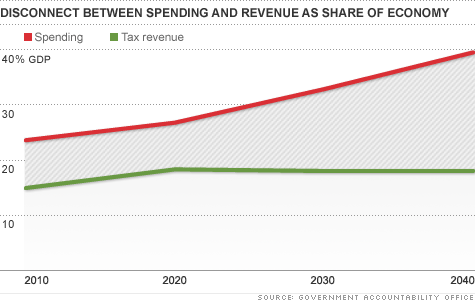

One of Newt’s former staffers, Yuval Levin, and David Brooks correctly point out both the moderate, north-east, country club nature of Newt and Romney’s “conservatism”, as well as Newt’s serious and deep flaws. David Brooks admires Gingrich’s zeal for smarter, targeted government, and not necessarily less government. See Brook’s assessment here. George Will recently made the same observation about Gingrich, but as pointed criticism, even commenting that Gingrich would have made a great Marxist. See here. Levin observes that from a policy perspective, Gingrich and Romney are practically indistinguishable, however, Romney presents a much more stable character. See here.
It seems to me that another Bush-Rockefeller president would keep us on the fast track to Europe’s present location: economic stasis and slow financial collapse. Unlike Europe, we’re not going to have the United States to help prop us up. Instead, we will have to rely upon the good intentions of the Chinese. Good luck with that.
If either of these men win the Republican nomination, the Republican Party is no longer the party of decentralized limited government and liberty. (Or maybe I’ll finally admit that’s been the case for some time.) Dr. Paul still offers the strongest cure for the soft despotism of the nanny state and ongoing fiscal insanity. See my case for Paul here. Bachman and Huntsman also offer correct solutions to these problems.
Obama is not the cause of our current malaise. He was popularly elected and may well be re-elected. He’s the symptom of poor political thinking within our republic, and only worse by degrees, not type, than the errant statist policies of his predecessors, Republican and Democrat.
We pray and have civilized discussions on these issues in an effort to convince our friends and neighbors. Our faith, however, is in another ruler.
and others should also:
See also: Why Not Ron Paul?
As an undergraduate at Purdue in 1987, one of my Professors, Harry Targ, lectured on the Cold War. He had just published his book Strategy of an Empire in Decline, in which he explained his belief in the moral, economic and political superiority of communism viz capitalism. In his mind, the USA Would not long withstand the inexorable and inevitable expansion of the Soviet Union. He was right regarding the collapse of an empire but wrong about everything else.
While Professor Targ is a run of the mill exemplar of the Marxist-Socialist bias in secondary education, he illuminates a larger point. He was a full-time academic on the Soviet Union. In 1986, there wasn’t serious discussion or analysis regarding the forthcoming USSR implosion. Notwithstanding his expertise on the Soviet Union, Professor Targ didn’t see the collapse coming in a relatively few years. None of us did.
Life works like that. Major historical events rarely appear obvious or inevitable as they happen. They are only clear in retrospect, if ever.
In contrast to the failure to foresee the swift and surprising nature of the USSR’s collapse, there are serious red flags that Western liberal democracies in general and the USA in particular have become financially, politically, and morally unhinged. Spending well beyond the available means is the norm not the exception for governments and families throughout the West. No leading political figure in any way advocates significant spending cutbacks.
We’re politically dysfunctional as the federal government divides fairly equally between those wedded to socialist statism and those that prefer corporate and military statism (while occasionally mouthing traditional conservatism).
Post-modernism has supplants Judeo-Christian beliefs as our moral foundation. Regarding sex, sexuality and marriage, what had been regarded as immoral, perverse and often illegal in the 1950s, is now acceptable and often routine and laudatory. When the highly accomplished Coach Paterno was fired for harboring a child molester on his coaching staff, thousands of students at one of our most esteemed Universities protested … not over the sexual improprieties that had occurred between Paterno’s subordinate and boys, but over the fact Paterno was fired over it. These outraged students are some of our most gifted minds and the future of this country.
There are clouds on our national horizon.
We should however fear and fret not. One kingdom will last forever, and it’s not our beloved USA. The everlasting kingdom will provide perfect justice and governance. As much as I love the USA and what we stand for, that future perfect government has not yet been established on Earth.
The future King of nations will not be delivered via an election. He will arrive with the sound of trumpets. Instead of water, he will baptise with fire, providing terribly perfect justice and loving grace. Under his perfect reign, the curse will be lifted and a new world reborn. Death will no longer sting and eternity will be a reality. That day should be our hope for the future. In Christ and not the works of mankind should we place our faith. Jesus Christ return and his perfect reign will endure forever. Pray soon. Amen.

Listening to the Occupy Wall Street crowd, I feel like I’m back in my undergraduate days, taking notes down from the lecture of yet another tenured, self-proclaimed Marxist professor. In attempting to explain the OWS motivation, the self-proclaimed Communist website Kasama explains,
It’s not that we don’t have demands; it’s that we speak them in a different language. We speak them with our struggle. Our movement is made up of people fighting for jobs, for schools, for debt relief, equitable housing, and healthcare. We are resisting ecological destruction, imperialism, racism, patriarchy, and capitalism.
See here. The only thing missing from this traditional Communist rallying cry is resistance against deism. In listening to the OWS crowd and trying to read what this somewhat inchoate mass puts out, it sounds just like a rehash of what the radical egalitarian, hardcore statist left-wingers have been advocating since at least 1917. Pajamas Media has compiled a list of those endorsing and supporting OWS, and it reads as a Who’s Who of the hardcore lefties, communists, socialists, and nationalist socialists (NAZIs). See here. Robert Laurie observes,
[A]ll of these disparate forces view capitalism and the United States as broken, deeply flawed constructs. The thing that unites them, no matter how unlikely their alliance may seem, is the idea that America needs to be undone and reconfigured as a country most citizens would scarcely recognize. As President Obama himself put it, America needs to be rebuilt ‘from the ground up.’
I was therefore surprised when I recently received an email from the North Carolina Secretary of State Elaine Marshall campaign bragging about her support for OWS. In her words and emphasis:
There are a lot of politicians trying to cozy up to Occupy Wall Street – but very few are actually hitting the streets to stand with them. That’s why I’m proud to be working for Secretary of State Elaine Marshall – someone who hasn’t just embraced the OWS protests, but has actually joined with them on the streets of Raleigh!
See Marshall OWS rally “pep talk” here. She concluded her OWS email endorsement with a request for a campaign contribution. It’s not a good time for the USA when mainstream, southern Democrats take the stage to endorse a movement of hardcore communists and other statists.
.
Categories
Why not Ron Paul?
“I mean, arguing over who mows Mitt Romney’s lawn … In the midst of a crisis, a sovereign debt worldwide crisis, the biggest in the history of the world, and the financial system of the world is about to collapse. We’re about to have another devaluation of … our credit rating. This is serious, and no control in the spending. We’re going to have to get a hand on this. We have to quit worrying over who’s mowing Mitt Romney’s yard.” Ron Paul, Meet the Press, Oct. 23, 2011
“Mommy, turn the car. We’re heading straight for a cliff.”
“Don’t worry, honey, we’re going to slow down some.”
The USA rapidly approaches an economic precipice and it’s much closer than we appreciate. If so, the 2012 election is a referendum on national cliff diving. The wreckage of great nations fill the history books, and rarely do last generations recognize the end before it’s too late.
We’re nearly 15 trillion dollars in debt, a number nearly beyond comprehension. See debt clock here. No nation in the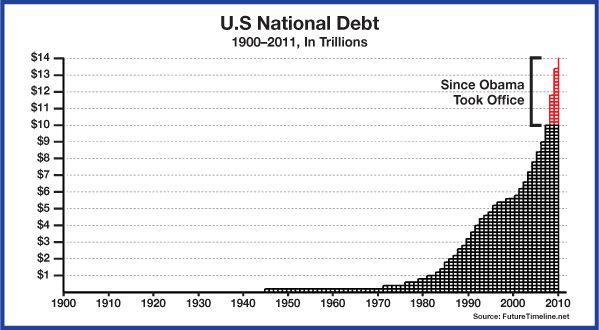 history of mankind has accumulated such a deficit when compared to the worldwide purchasing power of the respective debt. A few short years ago, our debt was nearly half of our GDP. In 2011, at the time of this writing, our federal debt is approximately equivalent to our GDP. See debt clock here. Even the CBO acknowledges imminent crisis. See here. All levels of government spending presently consume nearly half our GDP. See debt clock here. We’re adding trillions of dollars of new debt every year. How much is that? If you counted a $1 bill every second, it would take you over 30,000 years to count the first trillion dollars.
Newsweek’s Andrew Nagorski reports “America’s public debt could skyrocket from 44 percent of GDP before the 2008 financial crisis to 716 percent in 2080. If legislative reforms don’t expand the size of government, the CBO dials the projection back to 280 percent.” As Mark Steyn observes in his recently published, must-read After America, that’s the difference between dead and more dead. Business Insider magazine reports that only 58 percent of Americans have a job right now; the median yearly wage in the United States is $26,261 and the average American household is carrying $75,600 in personal debt. Including public and private debt, each American – man, woman and child – is each presently responsible for approximately $175,000 in debt. And the figure grows. See debt clock here.
The problem is systemic throughout the industrial nations and social-welfare states and no one is coming to our financial rescue. Unfortunately, the US is the leader in this fiscal suicide. A leading German economist recently explained, “The alarmingly high national debt many countries now hold, as compared to gross domestic product, is by no means simply a result of fiscal countermeasures taken after the global financial crisis of 2008-2009. It is just as much a product of a policy, carried out for decades and widely accepted, of perpetually borrowing money for public budgets.”
We don’t need to slow down this economic death spiral, we need an abrupt turn-around. Not a slight change of angle, but a U-turn. Our current path is unsustainable.
A new tax plan alone is not good enough, even if it means giving Congress a new pipeline to take money from us in the form of a sales tax. The problem is spending. The government of a free people should not be the largest employer, should not consume nearly half of the wealth of its people and should not burden yet unborn generations with trillions of dollars in debt. King George III should not get the last laugh.
We used to pride ourselves in being the land of the free and the home of liberty.
Government, particularly the national government, should not be the central or primary organizing power of a free people.
Not only are we not governing ourselves as a free people, but we no longer think of America as a land of freedom. Love of liberty no longer unifies us as a people. Our original national motto E pluribus unum means little to many.
So … in light of what appears to me to be a substantial, imminent and self-induced fatal threat to our Republic, I don’t particularly care who mowed Mitt Romney’s yard or about archival copies of President Obama’s birth certificate. Not surprisingly, Congressman Paul made the same points this past Sunday on Meet the Press. (Hat tip to and video of excellent responses to tough NBC interview available at The Corner here.) I don’t think our primary solution is a better energy program spearheaded by the federal government. Energy development and independence is important, but in the end, it’s another government project. We need far less government and we need that U-turn immediately.
Only one presidential candidate has presented any policy proposals that address the scope and root of our impending financial disaster. Dr. and Congressman Ron Paul’s “medicine” is strong and aggressive. He promises a balanced budget within three years, ie before what would be his reelection. It would not be easy or painless. Ron Paul proposes:
SPENDING: Cuts $1 trillion in spending during the first year of RonPaul’s presidency, eliminating five cabinet departments (Energy, HUD, Commerce, Interior, and Education), abolishing the Transportation Security Administration and returning responsibility for security to private property owners, abolishing corporate subsidies, stopping foreign aid, ending foreign wars, and returning most other spending to 2006 levels.
ENTITLEMENTS: Honors our promise to our seniors and veterans, while allowing young workers to opt out. Block grants Medicaid and other welfare programs to allow States the flexibility and ingenuity they need to solve their own unique problems without harming those currently relying on the programs.
CUTTING GOVERNMENT WASTE: Makes a 10% reduction in the federal workforce, slashes Congressional pay and perks, and curbs excessive federal travel. …
TAXES: Lowers the corporate tax rate to 15%, making America competitive in the global market. Allows American companies to repatriate capital without additional taxation, spurring trillions in new investment. Extends all Bush tax cuts. Abolishes the Death Tax. Ends taxes on personal savings …
REGULATION: Repeals ObamaCare, Dodd-Frank, and Sarbanes-Oxley. Mandates REINS-style requirements for thorough congressional review and authorization before implementing any new regulations issued by bureaucrats. President Paul will also cancel all onerous regulations previously issued by Executive Order.
MONETARY POLICY: Conducts a full audit of the Federal Reserve and implements competing currency legislation to strengthen the dollar and stabilize inflation.
Dr. Paul lists specifics, to include the numbers. See here. Recently, the Vision Forum gave Dr. Paul its highest grade in its analysis on how well the candidates’ proposed policies adhered to the US Constitution. See here.
Having delivered thousands of babies, Dr. Paul is also solidly pro-life. See here and here. He is a strong advocate for homeschooling; his campaign states “no nation can remain free when the state has greater influence over the knowledge and values transmitted to children than the family does.” See here and here.
Dr. Paul is not nearly as smooth or well-funded as Gov. Romney. Paul lacks Gov. Perry’s executive experience and made for the camera looks. He has no trace of Mr. Cain’s bold rhetoric and infectious smile. Dr. Paul has, however, diagnosed a terminal disease in this Republic and Dr. Paul is the only one promoting an adequate cure. Further, he made and has spent his life’s energy publicizing this diagnoses. Only now after the Bush-Obama fiscal conflagration do I appreciate the accuracy of what Ron Paul has been championing for years.
I have been on a whirlwind adventure the past few weeks, hopping around the country from one event to another. It all started in Orlando, when I was honored to present a workshop for folks attending the CareNet annual conference. My topic was timely in this coming election year – how can nonprofit charities exercise their First Amendment rights in light of the tax code and IRS regulations that restrict their ability to speak in the political sphere? CareNet people are passionately pro-life and would love to see pro-life candidates elected.
Charities can participate in lobbying to a limited extent but are absolutely prohibited from supporting or opposing a particular political candidate.
Charities can engage in “issue advocacy,” but need to be wary of traps—candidates talk about issues and plan their campaigns around issues. Frankly, I believe the restrictions are unconstitutional, but people need to be informed and either follow them or be prepared to litigate a test case.
I decided to make it fun – and easy (or at least easier) – to navigate the rules. We all wear different “hats” as we move into different roles in our personal and professional lives. I bought some party hats and gave them names: “Freddie Free Speech” (individual citizen), “Charlie, President of Choo Choo Charities” (official representative of charity), and “Cathy Candidate” (candidate for political office). Once you identify your “hat” and know WHO you are when you speak, you can jump into a series of familiar questions: WHO, WHAT, WHY, WHEN, WHERE, and HOW.
WHO: Are you speaking as an individual citizen (“Freddie”) with First Amendment rights, or as the representative of a charitable nonprofit (“Charlie”)? Do you want to invite a candidate (“Cathy”) to speak at your charity’s event, or simply introduce a candidate who happens to attend?
WHAT: Are you talking about a particular candidate, proposed or pending legislation, or giving a moral exhortation? Many issues overlap the religious/moral and political spheres in today’s world.
WHY: Are you trying to support or oppose a candidate – or legislation you want to see passed (or not)? Are you teaching a Bible study or giving a moral exhortation about an issue like abortion that is also a controversial political issue?
WHEN: Is it close to the time for an election, or a legislative vote?
WHERE: Are you at an official function for a charity you represent, or writing in an official publication for the charity? If so, you can’t remove your “hat.” Are you away from your charity, speaking solely as an individual and not on behalf of the charity? If so, you can put on your “free speech” hat.
HOW: How is the communication financed? How is it presented—does it appear that the charity is biased in favor or against a particular candidate? Has the charity provided an unbiased public forum for candidates—or perhaps given a candidate some advantage it doesn’t offer to others?
This is “food for thought,” as the IRS restrictions require some time to digest. I hope to write a short guide that is reasonably easy to navigate—with a touch of fun.
RALEIGH–The North Carolina State Senate voted yesterday to concur with a bi-partisan vote in the North Carolina State House to pass a Marriage Protection Amendment recognizing marriage as the legal union of one man and one woman. The Senate passed the Amendment 30-16, while the House vote was 75 to 42. Passage of the Marriage Protection Amendment by both houses of the General Assembly allows the issue to go to a vote of the people on the next primary election ballot scheduled to be held May, 2012.
If a majority of North Carolina voters support the Marriage Amendment in this referendum, the language of the amendment will be permanently included in the North Carolina Constitution, and North Carolina will join thirty other states that have protected marriage in their constitutions.
“This is a great day for the people of North Carolinato be able to vote on this important issue,” said Tami Fitzgerald, Executive Director of the N.C. Values Coalition. “The voters have waited for eight years to vote on protecting marriage, and the General Assembly has finally provided that opportunity to them.”
The floor debate in the Senate included discussion of the economic advantages the Marriage Amendment would bring toNorth Carolina. States that have protected marriage have better business rankings than states that have not or states that have redefined marriage. “Whether it’s Forbes magazine, the American Legislative Exchange Council, CNBC, Chief Executive Magazine or the National Chamber of Commerce, the overwhelming majority of the states in the top ten in economic performance in the country are states that protect marriage in their constitutions,” Fitzgerald said.
The Marriage Amendment will also protect private businesses by allowing them to continue to offer benefits according to their own strategic business decisions instead of government mandates.
The North Carolina Values Coalition has worked since February toward passage of the Marriage Protection Amendment and expects to play a key role in the campaign to get it passed on the next primary ballot. Citizens interested in getting involved and supporting the NC Value Coalition’s efforts on behalf of marriage should go to NCValues.org
Over at NRO, Peter Kirsanow suggests Today’s Questions for the President and presents the following facts:
- The top 1 percent of income earners pay 38 percent of all federal income taxes. They earn 20 percent of all (adjusted gross) income.
- The top 10 percent of income earners pay 70 percent of all federal income taxes. They earn 55 percent of all income.
- The top 25 percent of all income earners pay 86 percent of all federal income taxes. They earn 67 percent of all income.
- Approximately half of U.S. households pay no federal income taxes whatsoever
In response to President Obama’s recent suggestion that the gross budget deficits could easily be erased if more Americans were simply more willing to engage in “shared sacrifice.” Mr. Kirsanow poses the obvious question which the feckless US press corp hasn’t, whom does the president have in mind? Certainly not the bottom half of earners that pay effectively nothing.
But these statistics are more than just rhetorical push back points. In my opinion, the current distribution of burden for sustaining the federal behemoth is fundamentally immoral. A plurality of government spending is now entitlement spending, meaning that these spending patterns reflect a massive redistribution of wealth. We don’t all share in the burden of sustaining our civic government.
I can hear the standard refrain already – our impoverished shouldn’t be required to pay. Foremost, half our population isn’t impoverished, even by our “standard” of defining “poverty.” Second, our standard for defining “poverty” is suspect, particularly by historical standards. Most of whom we define as impoverished “suffer” air conditioning, Cable TV, and an Xbox. Our “impoverished” suffer the highest rates of obesity. Obesity is a serious health risk, perhaps the most serious modern epidemic, however, never before in history and almost nowhere in the world where true poverty is still known is “obesity” a symptom of poverty. There are some truly poor and downtrodden in the United States, however, it’s a small fraction of those “labeled” as in “poverty” in this country.
The vast majority of Americans can and should financially contribute to our shared form of government. It’s immoral to shift the burden onto a minority while conveying advantages without any payment to those that have the ability to pay.
The popular sentiment, however, remains that “the rich should pay more.” The United States is quickly becoming a land of “From each according to his ability, and to each according to his need.” Unfortunately, too few appreciate just how fundamentally un-American and illiberal is such sentiment and how dangerous it proved to be in the 20th Century when played out in places far away.
Categories
English Yobs
Just a few months ago, our family was studying the rich history of the English. We admired how the English planted worldwide highly refined views and systems of law, culture, and society. The English system as reflected in its former colonies and former and current Commonwealth has been a blessing to millions if not billions over time. The English belief in the rule of law, the common law, and the integrity of civil institutions has led to some of the freest and materially blessed countries in the world, to include our United States. Our British friends are a long way from Runnymede and it’s been a dark hour in what used to be the center of an empire where the sun never set.
Are the English riots symptomatic of something fundamentally astray in the UK? Are these the latest signs of the West unraveling? Or are these isolated, unique occurrences?
Mark Levin believes the British riots are not an isolated aberrant event, but are instead reflective of the ongoing and accelerating collapse of the West. See Levin: We are watching our society transform right before our eyes
Michael Youssef opines in Americans Should Learn from London, that those who sounded the warnings and tried to fix the UK’s unsustainable policies are being blamed for the violence and lawlessness – “whoever tries to bring sanity to a nation or a culture heading in the wrong direction will become the scapegoat.” The UK Socialist party readily agrees, at least that the Tory party reformers (conservatives) are to blame for the riots. Indeed, they argue that the violent protests are a response to “Tory attacks.” The British socialists explain the nature of these supposed attacks – reductions in social welfare and overall government spending. See here.
A Brit, Iain Murray has perhaps the most pointed and stinging critique of what gave rise to these mass acts of violence:
Most [rioters] have no jobs to go to or exams they might pass. They know no family role models, for most live in homes in which the father is unemployed, or from which he has decamped.
They are illiterate and innumerate, beyond maybe some dexterity with computer games and BlackBerries.
They are essentially wild beasts. I use that phrase advisedly, because it seems appropriate to young people bereft of the discipline that might make them employable; of the conscience that distinguishes between right and wrong.
They respond only to instinctive animal impulses — to eat and drink, have sex, seize or destroy the accessible property of others.
…
So there we have it: a large, amoral, brutalised sub-culture of young British people who lack education because they have no will to learn, and skills which might make them employable. They are too idle to accept work waitressing or doing domestic labour, which is why almost all such jobs are filled by immigrants.They have no code of values to dissuade them from behaving anti-socially or, indeed, criminally, and small chance of being punished if they do so.
They have no sense of responsibility for themselves, far less towards others, and look to no future beyond the next meal, sexual encounter or TV football game.
They are an absolute deadweight upon society, because they contribute nothing yet cost the taxpayer billions. Liberal opinion holds they are victims, because society has failed to provide them with opportunities to develop their potential.
Most of us would say this is nonsense. Rather, they are victims of a perverted social ethos, which elevates personal freedom to an absolute, and denies the underclass the discipline — tough love — which alone might enable some of its members to escape from the swamp of dependency in which they live.
Only education — together with politicians, judges, policemen and teachers with the courage to force feral humans to obey rules the rest of us have accepted all our lives — can provide a way forward and a way out for these people.
They are products of a culture which gives them so much unconditionally that they are let off learning how to become human beings. My dogs are better behaved and subscribe to a higher code of values than the young rioters of Tottenham, Hackney, Clapham and Birmingham.
See his full critique: The Failure of the Rule of Law in Britain
In unwittingly supporting Mr. Murray, two English women explained their motivation to riot: “It was madness, good fun … . Showing the rich people we do what we want.”
As always, Jonah Goldberg in Riot Rationalization Misses the Mark, makes eminent sense in cautioning against reading too much into a riot or series of riots, since riots have been around as long as human nature.
The problem, of course, is that even if conservatives are right, there’s precious little government can do to fill the holes in such souls.
Moreover, I think we put way too much effort into intellectualizing or romanticizing mob violence. Whatever the root causes of such behavior, the simple and unavoidable truth is that looters loot because they can.
…
[T]he people tearing apart English society are simply criminals, whose villainy is not diluted by their numbers, but magnified by them.
Solution? I think Mr. Goldberg provides a valid short-term solution: “If Britain lacks prisons to hold them, build more prisons. Call it a jobs program if it helps.”
Ultimately, however, Mr. Goldberg’s suggestion is myopic. You can never build enough prisons to restrain the vices of an immoral culture. The disease of systemic immorality is spreading across the West. Whether it’s a lack of respect for civil authority, rampant sexual promiscuity, normalization of perversion, a disregard for your neighbor’s property, or gross fiscal irresponsibility, the Western nations are rapidly loosing their moral bearings. Indeed, we’re rapidly becoming exemplars of Romans 1:18-32. This should not be surprising to Christians since over the past 100 years, particularly in Europe, westerners have strayed further and further away from Biblical truth and morality. You can build more prisons, but the answer long-term is in building more churches and training and equipping the next generation in the truths of God’s word.
A beauty of the West, thus far at least, is that we can openly observe, comment and argue over what we’re doing incorrect and right ourselves before it’s too late. While there is presently much going wrong with western liberalism, there’s nothing so drastic that an open, free and determined people cannot overcome.
[revised 8/15/11]
Categories
Remember
Remember all those times Newsweek went out of its way to make candidate Obama look like an inexperienced empty suit by their photo selections of him? And how the “mainstream” pubs treated him and Gov. Palin the same? Oh yeah, forgot. That never happened. See Andrew Cline’s The Newsweek Bachmann Cover
Remember all those times NPR went out of its way to make evolutionary zealots look bad and gave even voice to biblical Christians? Never happened. Never will. NPR dedicated a piece during prime drive time this morning to parroting the recent Christianity Today cover article showcasing the leading evangelical compromisers on human origins. NPR phrased the issue as whether evangelicals were going to rely upon the authority of science or lose all intellectual credibility and stick with the authority of scripture – the classic science v. Bible false dichotomy. The only positive in the coverage was that they did take a few seconds to talk to one Biblical evangelical, Dr. Mohler, which is more than I recall Christianity Today having done. NPR also gave Dr. Mohler the last word and he used his soundbite well, stating “The moment you say ‘We have to abandon this theology in order to have the respect of the world,’ you end up with neither biblical orthodoxy nor the respect of the world.”
Societies that jettison God’s truths devolve into moral bankruptcy. Systemic economic bankruptcy is typically tied directly to moral bankruptcy. Pray we turn this mess around here and in Europe. Interestingly, the church is thriving in the east, particularly in China and South Korea and their economies are booming. So far, the 21st Century is foreshadowing that 2100 will be more different from 2000 than 2000 was from 1900. Like the last century, technology will continue to transform cultures and societies, but it appears a significant geo-political and economic shift is occurring. Head West young man, so far you go east …
 Sapphire Sky