Happy Fathers Day!
Category: marriage and family
“The cause of sexual freedom, meaning the legalization of same-sex marriage, abortion on demand, and unlimited access to contraceptives, is advanced under a single overriding principle, that individuals should be free to do whatever they want with whomever they want so long as all participants are consenting adults. If that’s not freedom, what is? It might be the opposite of freedom actually.” Janie B. Cheaney, Bedroom Politics
We see an inverse relationship in the last 50 years, particularly in the West — as the institution of family weakens, the need for and intrusion of government – welfare and criminal – increases.
Robert George reminds us, “Liberty is valuable not so much for its own sake as for the sake of something larger, namely, human excellence or human flourishing. And … liberty is sustained—if it is sustained at all—by virtues that themselves must be transmitted by healthy institutions of civil society, beginning with the marriage-based family and communities of religious faith.”
Marriage is a civil right and a civil institution. The State’s interest in it is and always has been promoting the creation and nurturing of the next generation. See here. Jennifer Roback Morse explains in Privatizing Marriage Is Impossible:
Marriage is society’s primary institutional arrangement that defines parenthood. Marriage attaches mothers and fathers to their children and to one another. A woman’s husband is presumed to be the father of any children she bears during the life of their union. These two people are the legally recognized parents of this child, and no one else is. The grandparents are not; the former boyfriend is not; the nanny who spends all day with the kids is not. These two hold their parental rights against all other competing claimants. This is an intrinsically social, public function of marriage that cannot be privatized.
You might reply, “Dr. Morse, your understanding of marriage is all about parenthood, and not about marriage itself. Not every marriage has children, after all.” And it is perfectly true: not every marriage has children. But every child has parents. This objection stands marriage on its head by looking at it purely from the adult’s perspective, instead of the child’s. The fact that this objection is so common shows how far we have strayed from understanding the public purpose of marriage, as opposed to the many private reasons that people have for getting married.
If no children were ever involved, adult sexual relationships simply wouldn’t be any of the state’s business. What we now call marriage would be nothing more than a government registry of friendships. If that’s all there were to marriage, privatizing it wouldn’t be a big deal. But if there were literally nothing more to marriage than a government registry of friendships, we would not observe an institution like marriage in every known society.
God created a man and a woman to create and sustain new life — not two women or two men. Two moms don’t equal two dads. If you don’t believe in God, substitute “evolution”. Either way, it’s not by happenstance that it takes one male and one female to create a child. It also takes one male and one female to have the best opportunity to raise a happy and productive child. The state should not incentivize adults to deliberately create a child for purposes of raising the child without a father or without a mother. Those parts aren’t interchangeable. Children, particularly boys, need fathers. This isn’t just a point of theology or natural law, but is also demonstrable.
The pathology of fatherless homes in the country is staggering. Beyond poverty, there is an overwhelming connection between young men raised in fatherless homes and violent crime. Dr. Loren Moshen of the Nat’l Inst. of Mental Health analyzed US census figures and found the absence of a father to be stronger factor than poverty in contributing to juvenile delinquency. A group of Yale behavioral scientists studied delinquency in forty-eight cultures around the world and found that crime rates were highest among adults who as children had been raised solely by women. Dr. Martin Deutsch found that the father’s presence and conversation stimulates higher performance at school. John Hopkins researchers found that young white teenage girls living in fatherless families were 60 percent more likely to have premarital sex. Dr. Armand Nicholi’s research found that an emotionally or physically absent father contributes to a child’s low motivation for achievement, inability to defer immediate gratification for later rewards, low self-esteem, and susceptibility to group influence and to juvenile delinquency. We should be doing everything in our power to make sure children are raised by a mother AND a father.
Weakening the family inexorable leads to greater poverty, more crime, and poorer education. These pathologies in turn lead to more government. While it seems counterintuitive, the more the state supports and encourages strong families, the less prone we will be to larger and more intrusive government.
On Monday night, I participated in a debate with Pastor Patrick Wooden, Professor Maxine Eichnor and State Rep. Deborah Ross on the NC Marriage Amendment. The forum was sponsored by Tom Campbell of NC Spin. Pastor Wooden and I spoke in favor of the amendment, the other two opposed. Mr Campbell did a good job controlling the debate and moving the topics along. WRAL recorded the entire debate and has it on their website here. We each had four minutes for an opening statement and were to have one minute for closing statements, with the better part of two hours of debate and Q&A between. We ran late, so our closing statements were 30 seconds — what follows is what I prepared in advance for the opening and closing:
Durham Debate
April 30, 2012
Marriage is a complex subject. It is a legal term, a religious term, a civil institution, and a personal commitment.
The Marriage Amendment presently before voters addresses the legal and civil institution of marriage. This is not a vote on private religious ceremonies, or about making homosexuality legal or illegal.
Civil institutions like marriage exist to serve a public purpose. Civil institutions exist to influence behavior, to encourage or discourage human conduct.
Since its existence as a colony some 350 years ago, the institution of marriage in North Carolina has been the legal union of one man to one woman for the purpose of having a family. Marriage provides an incentive and protection for a man and a woman to bond for the purpose of creating and raising the next generation in a secure environment.
The State’s interest in marriage is the generation of the next generation. The reproduction and healthy upbringing of the next generation is the most fundamental of social functions. It is that fundamental and foundation function which warrants government incentives and protection of marriage.
Since the 1960s, we’ve been redefining the purpose of sex, to be less about procreation and more about recreation. Starting in the 1970s, we began redefining marriage to be less about the commitment to raising a family and more about adult liberty and satisfaction.
The results of this so-called sexual revolution and it’s cousin the no-fault divorce have not been good for families or for children. Homosexual marriage takes society further down the road of redefining the most fundamental of institutions to be about the liberty interests of adults and not about one man and one woman raising a family.
The western liberal democracies have been engaged in redefining sex and marriage away from procreation since the 1960s. The results have been catastrophic, with most of our liberal democracies suffering skyrocketing rates of single parenthood and collapsed fertility rates. The data is unambiguous. The West is committing demographic suicide.
Homosexual marriage is not the answer. Same sex marriage converts marriage from being child centric to being adult centric. Marriage must be about encouraging men and women to create children and stick it out through good and bad to raise those children together as a father and mother team.
Children raised by their mother and father is the gold standard. Regardless of how much two homosexuals might love each other, two men do not replicate a child’s mother. Similarly, two women do not replicate a child’s father. There is no public purpose served in incentivizing homosexual unions and the state should not incentivize homosexual parenting, nor should the state incentivize polygamous or polyamorous parenting or any other substitute for one man and one women raising their children. Keep in mind that we’re talking about incentivizing behavior through a civil institution. This is about government incentives, this is not about making relationships legal or illegal.
The homosexual lobby has conducted a public relations scare campaign to convince voters about the Marriage Amendment. The homosexual lobby has tried the same tactics in dozens of prior campaigns across the United States. In 30 out of 30 earlier votes, the voters knew better. And in 30 out of those 30 prior amendments, no such harms have come to pass. The arguments are legally frivolous and often outright false.
The homosexual lobby claims that the NC language is radical or somehow vague or mysterious. These claims are utterly false. Please read the Marriage Clauses in the Constitutions of Virginia and South Carolina. Look at Idaho’s also. It’s Amendment is six years old and nearly identical to NC’s. Please also check Black’s Law dictionary, the Federal DOMA, and about a dozen other State’s already passed marriage amendments. North Carolina’s amendment is very well written and would leave the decision of whether to redefine marriage in the hands of the citizens, and not radical lawyers, judges or politicians.
CLOSING REMARKS
Rob Agnelli recently said,
Because marriage has such a profound effect on society as a whole, the state has a compelling interest in it. … Marriage as a social institution possesses certain qualities that offer an irreplaceable benefit to society. Through the lifelong commitment of the spouses, the most stable conditions for raising children are created. Through sexual differences parents provide their children the full range of human love that comes by being raised by their mother and father. Marriage binds parents and children together and thus serves the common good. No other relationship involving parents and children can adequately substitute for these natural ones.
The more marriage ceases to be about the life long commitment of a man and a woman to raise a family, the less marriage produces life long commitment, and the less it produces family and children.
All citizens of North Carolina, gay and straight, are respected and welcomed and they have the right to private commitment ceremonies as they choose. But, they do not have the right to redefine marriage for our State and demand that the state incentivize and promote homosexual unions through the institution of marriage.
Marriage is the foundation institution for creating, sustaining and raising the next generation. The Marriage Amendment leaves it in the hands of North Carolinians, and not attorneys, to keep it that way.
Authors: Patrick F. Fagan, Andrew J. Kidd and Henry Potrykus
Executive Summary
The economic well-being of the United States is strongly related to marriage, which is a choice about how we channel our sexuality. The implications of sexual choices are apparent when comparing family structures across basic economic measures such as employment, income, net worth, poverty, receipt of welfare, and child economic well-being. In all of these the stable, intact married family outperforms other sexual partnering structures; hence the economy rises with the former and encounters more difficulties and inefficiencies as it diverges from it.
Family Structures and Economic Outcomes:
- Employment and Income. Married-couple families generate the most income, on average. Young married men are more likely to be in the labor force, employed, and working a full-time job than their nonmarried counterparts. Cohabiting men have less stable employment histories than single and married men. Married families generally earn higher incomes than stepfamilies, cohabiting families, divorced families, separated families, and single-parent families. According to one study, married couples had a median household income twice that of divorced households and four times the household income of separated households.
- Net Worth. Intact, married families have the greatest net worth. A family’s net worth is the value of all its assets minus any liabilities it holds. Married households’ net worth is attributable to more than simply having two adults in the household: a longer-term economic outlook, thrift, and greater head-of-household earning ability (the marriage premium) all contribute to greater household net worth.
- Poverty and Welfare. Poverty rates are significantly higher among cohabiting families and single-parent families than among married families. Over one third of single mothers live in poverty. Nearly 60 percent of non-teenage single mothers rely on food stamps or cash welfare payments.
- Child Economic Mobility and Well-Being. Children in married, two-parent families enjoy more economic well-being than children in any other family structure. Children in cohabiting families enjoy less economic well-being than children in married families, but more than children in single-parent families. The children of married parents also enjoy relatively strong upward mobility. By contrast, divorce is correlated with downward mobility. A non-intact family background increases by over 50 percent a boy’s odds of ending up in the lowest socioeconomic level.
Married Families:
Married men enjoy an income increase called the “marriage premium.” Married families also tend to save more, have higher net worth, and enjoy greater net worth growth from year to year. Furthermore, the presence of both parents at home is strongly beneficial for children, giving both parents myriad more options in devising their income and parenting strategies, resulting in increased economic well-being.
Remarried Families:
Remarriage may improve women’s incomes after divorce, though men who remarry after divorce have, on average, less net worth than continuously-married men. Many remarried spouses choose to keep money in separate accounts rather than pooling all their resources. Poverty is reduced by 66 percent among children whose divorced mothers remarry.
Divorced Families:
The income decline that follows divorce, particularly among women, is well documented. Divorcing or separating mothers are 2.83 times more likely to be in poverty than those who remain married. Following a divorce, the parent with custody of the children experiences a 52 percent drop in his or her family income. The children of divorced mothers are less likely to earn incomes in the top third of the income distribution, regardless of where in the income distribution their parents’ income fell.
Single-Parent Families:
Single parents have a particularly difficult economic situation. Single mothers over age 20 more closely resemble teenage single mothers than they resemble married mothers their own age when their children are born. Single mothers have less net worth than married parents, single fathers, and stepfamilies; their net worth is comparable only to cohabiting couples. Over one third of single mothers live in poverty. Children in singleparent households have less family income and are more likely to be poor than children in married-parent households.
Cohabiting Families:
Cohabiting households generally have larger incomes than single-parent households but smaller incomes than married-parent households. Cohabiting women work more hours as their partner’s income increases because they deliberately avoid an agreement to totally pool their incomes. Cohabitors who live together for less than four years are not likely to pool their incomes. Older cohabitors who have never been married have, on average, 78 percent less net worth than those in intact families. Furthermore, cohabiters have the lowest net worth growth of all family structures, comparable to that of widows and widowers.
As previously noted, on May 8th, voters in North Carolina will decide whether to add to the State’s constitution a provisions that provides:
“Marriage between one man and one woman is the only domestic legal union that shall be valid or recognized in this State. This section does not prohibit a private party from entering into contracts with another private party; nor does this section prohibit courts from adjudicating the rights of private parties pursuant to such contracts.”
Opponents claim that the proposed Amendment ultimately could deny domestic violence protections, child custody and visitation rights, and other legal benefits to thousands of unmarried couples in NC. Their concerns are based on a legal analysis of the Amendment published by Maxine Eichner, a law professor at UNC School of Law and a leading academic on feminist and queer legal theory.
Campbell law professors Lynn Buzzard, William Woodruff, and Gregory Wallace have published a detailed reply to Eichner disputing the accuracy of her legal analysis and rejecting her stated concerns regarding how the Amendment might harm unmarried couples. The Campbell professors’ purpose is to advance the public dialogue by addressing the flawed analysis of Eichner, whose misleading claims have provided the basis for the opposition’s ongoing scare campaign. The professors explain,
The reason for this paper is a narrow one. We do not endorse or oppose the proposed Amendment. There are thoughtful arguments on both sides, and we encourage a robust public debate about the Amendment. Our aim instead is to help clarify for North Carolina voters the Amendment’s legal meaning and likely effects. We believe that the Amendment debate has been distorted by concerns over certain legal consequences that are highly unlikely to occur. … We emphasize again that it is not up to us to tell anyone how to vote on the proposed Amendment. We offer this paper only as a modest attempt to explain the meaning and likely effects of the Amendment, should it pass. We believe that North Carolina voters are best served by having accurate legal information about the Amendment, so that they can properly consider the Amendment’s pros and cons and then vote their conscience.
The Campbell Law professors conclude that even if the Amendment passes, unmarried and same-sex couples still will be protected under domestic violence laws, would retain their current rights to child custody and visitation, and could continue to received public health insurance benefits.
The three professors state that because the Amendment applies to “legal unions” and not “relationships,” it bars only same-sex marriage and legal recognition of civil unions and domestic partnerships that resemble marriage unions. The flaw in Eichner’s arguments is that she does not give the term “legal union” its proper legal effect in construing the Amendment. (Eichner admitted to me in debate that even without the “domestic legal union” clause, she still would not support a prohibition against same-sex marriage.)
The law professors’ full, detailed analysis can be found here: The Meaning and Potential Legal Effects of North Carolina’s Proposed Marriage Amendment
The living God speaks to, guides, comforts and strengthens us through prayer. Through prayer, God is the cement that bonds a husband and wife. The Bible instructs us to pray continually. (1 Thes. 5:17.) Although trite, a family that prays together, stays together. Both within the “church” and in society at large, roughly fifty percent of all marriages end in divorce. Those numbers within the church break down, however, upon inspection. Amongst couples who pray together, the divorce rate plummets to less than one percent.[i] Prayer demonstrates the power of the living God in the lives of people. A commitment to praying together on a daily basis should be included in the wedding vows of every Christian couple. Imagine the witness to this fractured and hurting world if over ninety-nine percent of all married Christians remained married until death intervened. Marital prayer fosters intimacy and love with each other and with God. It demonstrates the Way to our children and invites blessing to the family.
The North Carolina Marriage Amendment is modeled after Idaho’s, as shown below. As shown below, the North Carolina Amendment is less restrictive than Virginia’s, effectively the same as South Carolina’s and more restrictive than Tennessee’s. In my opinion, the North Carolina Amendment is the most clear and concise as compared to our surrounding States.
North Carolina the Marriage Amendment:
Marriage between one man and one woman is the only domestic legal union that shall be valid or recognized in this State. This section does not prohibit a private party from entering into contracts with another private party; nor does this section prohibit courts from adjudicating the rights of private parties pursuant to such contracts.
Idaho Amendment (2006):
A marriage between a man and a woman is the only domestic legal union that shall be valid or recognized in this state.
[Unlike the NC version, Idaho does not expressly protect private contracts pertaining to domestic relations between same sex adults]
Virginia Amendment (2007):
Only a union between one man and one woman may be a marriage valid in or recognized by this Commonwealth and its political subdivisions. This Commonwealth and its political subdivisions shall not create or recognize a legal status for relationships of unmarried individuals that intends to approximate the design, qualities, significance, or effects of marriage. Nor shall this Commonwealth or its political subdivisions create or recognize another union, partnership, or other legal status to which is assigned the rights, benefits, obligations, qualities, or effects of marriage.
[prohibits same sex marriage, civil unions, and private contract]
South Carolina (2006):
This amendment provides that the institution of marriage in South Carolina consists only of the union between one man and one woman. No other domestic union is valid and legal. The State and its political subdivisions are prohibited from creating or recognizing any right or claim respecting any other domestic union, whatever it may be called, or from giving effect to any such right or benefit recognized in any other state or jurisdiction. However, this amendment also makes clear it does not impair rights or benefits extended by this State, or its political subdivisions not arising from other domestic unions, nor does the amendment prohibit private parties from entering into contracts or other legal instruments.
[prohibits same sex marriage and civil unions]
Tennessee (2006):
The historical institution and legal contract solemnizing the relationship of one man and one woman shall be the only legally recognized marital contract in this state. Any policy or law or judicial interpretation, purporting to define marriage as anything other than the historical institution and legal contract between one man and one woman is contrary to the public policy of this state and shall be void and unenforceable in Tennessee. If another state or foreign jurisdiction issues a license for persons to marry and if such marriage is prohibited in this state by the provisions of this section, then the marriage shall be void and unenforceable in this state.
[prohibits same sex marriage]
On May 8, 2012, North Carolinians will vote on whether to add the following language to the Constitution of North Carolina:
Marriage between one man and one woman is the only domestic legal union that shall be valid or recognized in this State. This section does not prohibit a private party from entering into contracts with another private party; nor does this section prohibit courts from adjudicating the rights of private parties pursuant to such contracts.
Meanings often change with times. The meaning of a word changes when people use it in a new and different way.
Gay. Fifty years ago, if I told you I was gay, it would mean something quite different than what it means to people today.
Word usage by people determines new meanings.
Marriage.
It’s a word. But it is also a civil, legal and religious institution. I support the NC Marriage Amendment because I believe the legal and civil purpose for the institution of marriage is to protect and encourage the lifelong commitment between one man and one woman to raise a family. Marriage is the institution designed for the creation and nurturing of children.
I will offer the following four points:
1. Some say that we do not need the Marriage Amendment because it already reflects the status of state and federal statutory law. However, I believe that the Marriage Amendment is necessary to ensure that marriage is defined by the people of North Carolina, and not by a handful of judges. As a Constitutional amendment, the people of North Carolina would directly control the meaning and purpose of this institution.
2. There are two views of marriage in this debate – the traditional view that the institution of marriage is the lifelong commitment between a man and a woman to create, sustain and raise a family. The competing view purposes the institution for adults to express and validate lifestyle choices. Some have characterized this debate as “child centric” versus “adult centric” views on marriage or whether the institution is tied to promoting procreation.
3. The law is normative. How you define the purpose for the institution of marriage has consequences. When the institution of marriage is no longer about a lifelong commitment to family and children – it stops functioning to produce commitment, family and children. Accordingly, the countries that have been progressively redefining marriage to be about adult preferences, marriage and reproduction rates are plummeting to dangerously low numbers. I find merit to the concerns expressed by some that the West is committing societal suicide by demographics.
4. The numerous and mutating objections about the Marriage Amendment causing harm to families, business and domestic violence protections are disingenuous and ignore what has happened in the 29 other states that have amended their constitutions to ban gay marriage. Critics have failed to put forward credible evidence of these threatened harms occurring in these numerous states over the past several years.
This brings us to the first issue with the Marriage Amendment –
I. Is the Marriage Amendment necessary?
YES. American’s have not redefined the word nor the institution of marriage. The effort to redefine marriage has been spearheaded by lawyers, the legal academic elite and a handful of judges.
Institutions and morals can change with times. When morals change, the law often changes to reflect the new values. But there’s no evidence the meaning of the word has changed through popular usage nor the institution.
The black letter dictionary on law – Black’s Law Dictionary defines marriage as the legal union of one man and one woman as husband and wife. The second edition of the Oxford American Dictionary is the most recent, comprehensive lexical analysis of American English. Completed in 2005, it defines marriage as the union between a man and a woman.
Similarly, our current statutes reflect the view that marriage is between a man and a woman. The federal Defense of Marriage Act, signed into law by President Clinton states that “’marriage” means only a legal union between one man and one woman as husband and wife …) 1 USC § 7. North Carolina General Statute § 51-1.2 establishes that same sex marriages are not valid in North Carolina.
However, the force for changing the definition of marriage to include gay marriage was a handful of judges and the power of their courts. Eight states recognize homosexual marriages – the first three States in our Republic to do so – were the result of judicial decree.
Massachusetts: May 17, 2004, Court Order
Connecticut: Nov. 12, 2008, Court Order
Iowa: April 24, 2009, Court Order
Vermont: Sept. 1, 2009, Legislation
New York: June 24, 2011, Legislation
New Hampshire: Jan. 1, 2010, Legislation
Washington: Feb. 14, 2012, Legislation
Maryland: passed Mar. 1, 2012; effective Jan. 1, 2013, Legislation
This issue of marriage should be resolved by the people of North Carolina and not by attorneys or judicial decree. Through the legislative process, only five states have adopted homosexual marriage. In contrast 29 states have expressly prohibited homosexual marriage by Constitutional Amendment, and one state has passed a constitutional amendment authorizing the legislature to ban gay marriage.
10 States w/amendments that ban same-sex marriage: Alaska, Nevada, Mississippi, Missouri, Montana, Oregon, Colorado, Tennessee, Arizona, California – whose ballot initiative banning gay marriage is presently enjoined by the 9th Circuit
18 States w/amendments that ban same-sex marriage & civil unions but not other contracts: Nebraska, Arkansas, Georgia, Kentucky, Louisiana, North Dakota, Ohio, Oklahoma, Utah, Kansas, Texas, Alabama, Idaho, South Carolina, South Dakota, Wisconsin, Florida
2 States w/amendments that ban same-sex marriage, civil unions & related contracts: Michigan, Virginia
The people, not a judge, should decide whether we want to redefine what marriage means in North Carolina. If the Marriage Amendment is passed by the voters, then under state law, it can only be changed by a vote of the people.
II. The traditional versus the radical feminists and critical legal theorist’s theory of marriage
What’s the purpose for the institution of marriage? Why do we have “marriage”?
Is marriage primarily about family or about the individual’s liberty of lifestyle?
How you answer this should largely inform your views on whether you think the institution of marriage ought to include homosexual partners.
A. The traditional definition of marriage.
In his 1828 American Dictionary of the English Language, Noah Webster defined marriage as follows:
The act of uniting a man and woman for life; wedlock; the legal union of a man and woman for life. Marriage is contract both civil and religious, by which the parties engage to live together in mutual affection and fidelity, till death shall separate them. Marriage was instituted by God himself for the purpose of preventing promiscuous intercourse of the sexes, for promoting domestic felicity, and for securing the maintenance and education of children.
Webster’s definition reflects the traditional, Judeo-Christian perspective on marriage. This is the definition to which the people of the Carolinas have regulated the legal institution for over 343 years, since the original royal charter of the Province of Carolina. It is the view held uniformly throughout the West for the past 2000 years, until about 20 years ago.
Under this traditional view, marriage is a life long commitment between a man and a woman and is the foundation of the family. The family is the foundation of society as it is the family that creates, nurtures and raises the next generation. In this view, marriage is a sacred bond between the man and woman, in the presence of the family, friends and before God. The family is the foundation of any and every society.
The traditional view on marriage is premised on the idea that marriage and raising children are hard work that requires a lifetime of largely selfless commitment. The institution of marriage is to encourage and protect that union and labor for the benefit of the children.
The traditional view of marriage is also premised on the idea that society should promote and protect children being raised by their biological mothers and fathers who are committed and legally obligated to the well being of the family. There is great and ancient wisdom in this sentiment that we should all recognize. There is an overwhelming common pathology in our prisons and on our welfare roles: children raised without their fathers. Every year about one million more children are born into fatherless families. If we have learned any policy lesson well over the past 35 years, it is that for children living in single-parent homes, the odds of living in poverty are great. The policy implications of the increase in out-of-wedlock births are staggering. Marriage drops the probability of poverty by 80%.
Decades upon decades and hundreds if not thousands of empirical studies repeatedly demonstrate that children raised in a home with their married mother and father are substantially more healthy, wealthy, happy, and productive than their counterparts who were not.
Under the traditional view of marriage and family – the self is subordinated to the good of the family, particularly to the good of the children. Through the traditional institution of marriage, adult society protects, promotes and encourages a child’s right to be raised in a secure environment by his or her biological parents. The traditional view of marriage is child focused.
B. The radical feminist and critical legal theorist’s view of marriage.
The moral and legal theory behind the gay marriage effort finds its genesis in radical feminist and queer legal theory[1], the scholars of which are not laudatory of the traditional institution of marriage.
The motto of the feminist legal theorists and sexual revolutionaries of the late 60s was “smash monogamy”. Marriage was portrayed as an institution of suppression. Now, a generation later, they are fighting for homosexuals to be admitted into the legalized institution of monogamy – marriage.
This isn’t irony. It’s intentional. It’s a deliberate and ongoing effort to redefine how society views and lives marriage. From this radical perspective, the primary purpose of the institution of marriage is to fulfill and validate the individual’s liberty of lifestyle, be it heterosexual, gay, lesbian, transgender, polygamous, or polyamorous. Same sex marriage repurposes marriage from a child-focused institution to an institution focused on validating and facilitating the expressive desires of adults.
Under this individual liberty view of marriage, marriage exists as an institution through which adults live and express themselves on the issues of family and sex.
This radical individualism and radical egalitarianism is not something new. In fact, it’s not even new to the institution of marriage. Starting in the 1970s, we began redefining marriage. Now if marriage doesn’t make you happy, end it. The no fault divorce – divorce rates since the 1980s have vacillated between 40 to 50%.
Instead of a lifelong commitment to the family, we began changing the institution of marriage into a perishable commodity. The institution is still focused on family and children, but only for so long as we feel like it.
The youth of today are the first generations raised in the culture of disposable marriage. It also shouldn’t be surprising then for us to find that a majority of these youth attach little moral, legal, or emotional significance to the institution of marriage being extended to gay adults who want to “enjoy” this celebration of individual liberty.
I respectfully suggest, and having lived through it personally can testify, that this concept of marriage as a disposable commodity is not at all healthy for children nor for the future of this Republic.
The proper view of marriage in a healthy society is that marriage is a life long union between a man and woman for purposes of raising a family together. Marriage should remain child focused.
The underlying issue pertaining to the Marriage Amendment is not about homosexuals raising children. It’s about the purpose of marriage: is it an institution to celebrate individual liberty, or is it a lifelong commitment between a husband and wife for the purpose of raising their children?
Marriage should not be an institution for validating sexual preferences. The institution of same sex marriage would change the institution of marriage from a child-focused institution to an adult-centered institution.
Deliberately conceiving a child with the life plan that he or she will never have a relationship with his or her father is unjust and cruel to the child. Sex is not an irrelevant category for parenting. All else being equal, children do better when there is both a mother and father in the home dedicated to raising them. Further, there is already a crisis of absentee fathers in this country.
The West has led the world in redefining marriage to be about individual liberty interests. There has been a pronounced and undeniable impact, and it has not been family or child friendly.
III. There are serious consequences to redefining marriage to be about the wants and needs of adults.
When marriage stops being primarily about commitment to and raising a family, then marriage stops producing commitment and family.
We talk a lot about the importance of education for equipping the next generation for tomorrow. But there is a more important, a more fundamental imperative for our children’s future: the future first belongs to those that show up. Our Western liberal democracies are showing an ever fading interest in showing up for tomorrow. To the contrary, there is compelling evidence that we are in a demographic death spiral, particularly in Europe, which spiral appears to have started with our redefining the institution of marriage to be about the wants and needs of adults instead of the creation and sustenance of families, i.e. children.
The family in the West is crumbling and our reproductive rates are plummeting.
1. Netherlands in 2001 legalized gay marriage – the public debate there and lawsuits started in earnest in 1989. I was there in 1990. A funny thing happened. Starting in the 1990s, the institution of marriage began to crumble. In 1995, 15% of births were out of wedlock. By 2009, out of wedlock births increased to 41% of births;– fertility rate of 1.78 children per couple. A healthy country requires a fertility rate of 2.1 to sustain its population;
You cannot prove causality – however, free and open sexual expression and treating marriage as a validation of lifestyle choices has not produced more families or more children. The opposite has happened.
The law is normative. It counsels what is acceptable conduct. Gay marriage is about validating the liberty of lifestyle choices. When the institution of marriage is no longer about commitment, family and children – it stops functioning to produce commitment, family and children.
2. Belgium legalized homosexual marriage in 2003 – from 1995 to 2009, out of wedlock births increased from 18% to 42% of births out of wedlock; fertility rate of 1.65
3. Spain legalized homosexual marriage in 2005 – from 1995 to 2009 – out of wedlock births increased from 10% to 32%; fertility rate of 1.48
United States – we presently have a fertility rate of 2.06; our births out of wedlock were 41% in 2008 according to the CDC. Within that, for Asian’s the rate is 17% of births out of wedlock, 28% for whites, 52% for Hispanics, and 72% for blacks. Marriage and procreation are already under great duress in this country. The collapse of the institution in the United States coincides with the advent of the “no fault” divorce here. Making the institution of marriage even more adult and expressive centric will likely only lead to what we see in Europe – a collapsed institution and unsustainable level of procreation.
Procreation is the most fundamental function of a healthy society.
How do these fertility rates compare with countries that have not followed the lead to make marriage about adult expression? You need 2.1 fertility rate to sustain.
Brazil has a fertility rate of 2.2.
Mexico has a fertility rate of 2.5
India – 2.58 fertility rate
Egypt – 2.94 fertility rate
Pakistan – fertility rate 3.52
The nations that have openly and aggressively redefined marriage to be adult focused are perhaps not surprisingly, not having children. Examining the countries that have led the way on gay marriage, we find fertility rates from 1.48 to 1.78. That’s not family friendly.
To the contrary, the West is in a demographic death spiral. This will result in declining and aging populations; changed social relations, economic pressure from shrinking populations; and if given large immigration patterns with disproportionately higher birth rates persist (which is the case in Europe with robust fertility rates within the immigrant Muslim demographic) – we will have entirely changed cultures/societies within a few generations.
When the institution of marriage ceases to be about children, sustainable reproduction dies and you have a dying country.
The institution of the family is in duress across the very Western liberal democracies that have taken it upon themselves to redefine the purpose of marriage. We should not redefine the institution further. Marriage should be about the life long commitment of a man and a woman for the purposes of raising their biological children.
IV. Subterfuge Arguments
There have been numerous allegations that this Amendment would have countless unanticipated ramifications that would hurt children and families.
Most of these claims lack merit.
1. The Amendment cannot be both unnecessary and too dangerous? On the one hand, critics claim the Amendment is unnecessary because it doesn’t change the current status of the law. On the other hand, we’re told that the Amendment will harm heterosexual couples. If the amendment does not change the legal status quo, it should have no affect the day after enacted. The only difference the day after enactment is that the people of North Carolina will control the definition of marriage in North Carolina.
2. What’s the motive? This debate is not about the wording of the Amendment. The people raising these arguments do not want to fix imprecise wording. The wording is not imprecise. The people making these arguments object to the traditional notion of marriage being the institution through which one man and one woman raises a family. They object to the fundamental moral dispute. Not the wording of how it is enacted. They do not support a more carefully worded restriction.
3. We’re not the first. We’re looking at being the 31st State to pass a constitutional amendment limiting marriage to one man and one woman. The critics’ unintended consequences arguments might be more persuasive if we were the first state to pass such an Amendment. Or maybe if we were the second, third or even fourth state. We’re not. This Amendment was based on studying the 30 current amendments already on the books and enforced in other states. This is a well-worn path. From the 30 prior iterations, the critics have not produced any meaningful evidence of these harms. Our Amendment is nearly identical to Idaho’s amendment, which was passed in 2006. Critics cannot point to one adverse resulting event there. Our Amendment is far less restrictive than Virginia’s, yet again, there is not one example of harm there. Despite amendments in dozens of states for many years, there is no pattern or evidence of adverse, unintended consequences. Critics claims to the contrary are unsubstantiated.
4. Based on a 2011 report by the American Legislative Exchange Council, the Marriage Amendment should not adversely affect North Carolina’s economy. A 2011 report by the American Legislative Exchange Council ranked states by economic performance between 1999 and 2009 and by economic outlook. Eight of the top ten economically performing states have amendments banning homosexual marriage. None have legalized same-sex marriage, civil unions or domestic partnerships. Nine of the 10 states forecasted to have the poorest economic growth have legalized same-sex marriage, civil unions and/or domestic partnerships.
5. The amendment should not affect the enforcement of domestic violence laws. This is perhaps the most spurious of arguments. Out of 30 states having already amended their constitutions, the opponents rely upon an instance in Ohio where a trial court refused to enforce a domestic violence statute based on the Ohio Marriage Amendment. What the critics don’t tell you is that the trial court was reversed by the Ohio State Supreme Court in 2007. The critics rely upon a reversed decision that has nothing to do with North Carolina’s domestic violence statutes. For lawyers, the trial court’s decision is called bad precedent. See Ohio v. Carswell, 871 N.E.2d 547 (Ohio 2007)
6. The amendment will not nullify medical powers of attorney (MPOAs) wills and trusts if the parties are homosexual partners. Under G.S. 32A-18 “any competent person who is not engaged in providing health care to the principal for remuneration, and who is 18 years of age or older, may act as a health care agent.” The relationship between the patient and the designated agent does not matter. The intent of the testator and trustor is the “gold standard” in N.C. for interpreting wills and trusts. The amendment does not change the intent of the testator in either type of these instruments. The amendment explicitly states that it will not affect the rights of parties to enter into private contractual agreements.
7. The Marriage Amendment will not determine the custody and visitation rights of unmarried parents unless their behavior affects the child. Custody orders are based on the parent/child relationship, not on the domestic relationship between the parents. Courts have based custody and visitation on the “best interest of the child.” NCGS 50-13.2(2007) The sexual behavior of the party petitioning for custody or visitation is not determinative except as it affects the child. The “de facto parenting doctrine” was applied in 2010 in Boseman v. Jarrell, 704 S.E.2d 494 (N.C. 2010). The Supreme Court refused to allow adoption to an unmarried same-sex partner but did award joint custody and visitation rights to that non-biological same-sex partner who had become a de facto parent to the child.
8. Homosexual couples will still be able to visit each other in the hospital. I don’t believe there are visitation restrictions currently against homosexual couples in North Carolina, and we have not legalized gay marriage or civil unions. Further, I don’t think a public or private hospital could refuse the designation of an unmarried partner and remain in Medicare. the final rule from the Center for Medicare and Medicaid Services regarding hospital visitation, which can be found here: http://www.gpo.gov/fdsys/pkg/FR-2010-11-19/pdf/2010-29194.pdf, is a broad provision that, from my reading of it, basically says that if you want to participate in Medicare you must inform patients of their right to receive visitors and the hospital may not limit those visitation rights based on sexual orientation. I haven’t been able to find specific statistics on the percentage of that accept Medicare funds, but it must be extremely high.
CONCLUSION
All citizens of North Carolina, gay and straight, are respected and welcomed and they have the right to private commitment ceremonies as they choose. But, they do not have the right to redefine marriage for our State.
Marriage is the foundation institution for creating, sustaining and raising the next generation. When the institution of marriage is no longer about a life long commitment to family and children – it stops functioning to produce commitment, family and children.
For these reasons, I will be voting in favor of the Marriage Amendment.
[1] “Queer Legal Theory” is not a term of derision but is the term of reference used within academia to refer to a particular school of jurisprudence and its scholars. The leading academic proponent of same sex marriage in North Carolina, UNC Law Professor Maxine Eichner is a well known legal feminist in academia who is well versed in critical legal theory. Her most acknowledged work is a review of feminist and queer legal theory with regard to “sexual citizenship.” See Eichner, Feminism, Queer Theory, and Sexual Citizenship. The paper can be downloaded at http://papers.ssrn.com/sol3/papers.cfm?abstract_id=1451059
Dove Award? Grammy? Maybe not. Each child sings the song I sang to them as “their” lullaby song. Not sure where “It’s a Dad’s Life” came from …
Categories
Marriage Sunday – Please Pray
From Alan Sears at the Alliance Defense Fund:
As I am sure you are aware, the U.S. Court of Appeals for the Ninth Circuit issued its ruling in Perry v. Brown, the federal challenge to California’s marriage protection amendment. To the surprise of none of us here at the Alliance Defense Fund, Judge Stephen Reinhardt, the most overturned federal appeals judge in America, wrote an opinion striking down the expressed will of over 7 million Californians who voted to define marriage as only the union of one man and one woman.Of course, this case is far from over. This is one setback in a struggle which we will tirelessly fight – all the way to the United States Supreme Court, if necessary.The future for marriage, both in California and the nation, is far from decided by the events at the Ninth Circuit, and what is occurring in California is just another battle in the ongoing war over marriage. Nevertheless, the need for prayer has never been more urgent, for without Christ we can do nothing (John 15:5).
…We are encouraging this Sunday, February 26th to be a day for all believers, to pray for marriage – that marriages across our land will be strengthened, and that God’s design for marriage be upheld and honored. The document here is a prayer guide that we would encourage you to use, and pass along to others to inform them about this special day.Would you please consider sharing this with your pastor, Bible study, friends and family – so that as many believers as possible will know, and participate, in this day of unified, focused prayer? You can also encourage them to visit www.TellADF.org/marriage to find out more.Thank you for all you do to honor the Lord in your personal and professional life. May God continue to give us all more of His grace and blessing, as we endeavor to faithfully follow Him toward victory.With sincere appreciation and best regards.Yours for religious freedom in America,Alan E. Sears
In addition to praying for the institution of marriage in our country, we should be praying for our own marriages and for our spouses.
28And one of the scribes came up and heard them disputing with one another, and seeing that he answered them well, asked him, “Which commandment is the most important of all?” 29Jesus answered, “The most important is, ‘Hear, O Israel: The Lord our God, the Lord is one. 30And you shall love the Lord your God with all your heart and with all your soul and with all your mind and with all your strength.’ 31 The second is this: ‘You shall love your neighbor as yourself.’ There is no other commandment greater than these.” 32And the scribe said to him, “You are right, Teacher. You have truly said that he is one, and there is no other besides him. 33And to love him with all the heart and with all the understanding and with all the strength, and to love one’s neighbor as oneself, is much more than all whole burnt offerings and sacrifices.” 34And when Jesus saw that he answered wisely, he said to him, “You are not far from the kingdom of God.” And after that no one dared to ask him any more questions. Mark 12
We can best evaluate how well we love by those around us. The people with whom we spend the most time are the best indicators of whether we’re walking Jesus’ walk and displaying the fruits of a Christian life. Often, such people know us better than we know ourselves. Our conceit and wishful self-perception do not deceive them. Often, I’m tempted to define how Godly I am by how much time I spend doing purely religious activities, like reading my Bible, praying, and doing charity work. That’s probably not the best test though. I suspect the best way to measure whether we’re living the Christian life is to evaluate how well we love God and those around us. Perhaps the best way to love God is to share his love with those whom he created and died for on the cross.
To determine whether you love, evaluate whether you are loved. Be sensitive to whether co-workers are happy to see you at the beginning of the day. When you come home, look for family members greeting you with a smile. Does the dog wag its tail or run the other way? Intimacy begins with your family. I think it’s an act of worship to know the dreams of each member of your family and to dream with them, to hold them and let them know you love them. Praise and thank God in their presence for the gift of their life. Praise and thank God in your private prayers for them. Seek intimacy with friends. I naturally keep walls up, as I suppose most people do. As Christians though, we should be committed to opening up and knowing and loving those that God puts on our path.
Marriage is “ground zero” for most of us in learning to love purely. The sacrament of marriage continually requires the Christian application of selfless love. In marriage, two become one. There is no better place to witness the presence or absence of Christ-like love. In unconditional love, the marital union blossoms into a life-long relationship of trust, happiness, and peace. Without it, the relationship or a spouse withers and dies.
Too many churches ignore the Apostle Paul’s instructions to husbands and wives. The media gives critical attention to the role of the New Testament wife. Namely, in the book of Ephesians, as well as in other places, Paul called on wives to submit to their husbands and established that husbands are the head of the family. Our secular, non-believing compatriots ignore Paul’s instruction. Even for believers, Paul’s admonition sounds harsh to our modern, egalitarian ears. Unfortunately, the press reports only half the story.
In the book of Ephesians, in the very next paragraph, Paul calls on husbands to love their wives, “just as Christ loved the church and gave himself up for her … .” (Eph. 5:25.) Christ loved the church unconditionally and completely. (John 15:13.) Paul calls for a radical commitment. Unfortunately, our secular friends are not the only ones to miss the significance of Paul’s complete instructions; many Christians fail to realize the radical nature of Paul’s instruction. God calls the Christian wife to submit to a man whose duty it is to unconditionally and completely love her, even unto the point of his death. The wife is to submit to her servant of love. In such a relationship, there is simply no room for egos, pride, or selfish desires. In a relationship of submission and servant love, divorce is unthinkable, which explains why God hates divorce. (Mal. 2:16.) Christian marriage should shine as a light to the world, especially a world where the majority of marriages end in the tears of loneliness, betrayal and divorce.
Of course, this is often easier to understand than it is to live it. I’ve heard about Dads coming home from a long days work and finding the house in complete disarray, dinner uncooked, children swinging from the chandeliers, and Mom displeased over the whole affair. Of course, I’ve never come home to such an estate, however, this is often considered a state of normalcy in homeschooling families … so I’ve read. It’s also not unheard of for the Dad to get angry over this and to let his dissatisfaction be known.
It recently occurred to me how differently we men respond to other “crises.” In the Army, if I moved to reinforce a fellow soldier’s position and found the enemy breaking through the wire, it wouldn’t occur to me to get mad and insist that my fellow soldier work harder. I’d immediately jump in and help. On the football field, if my running back fumbled the ball, instead of getting mad and looking for blame, I’d immediately jump to recover the ball for our team. Same on the soccer field; if a fellow defender was beaten, I’d do everything I could to help stop the shot on goal. I should have that exact same spirit and immediate response when I get home and find my spouse under duress, but that’s quite often not my natural response, yet my family is the most important team I’ll ever be on and my wife my lifetime MVP.
Let us encourage each other to be of good cheer and to do good works pleasing to Jesus. Rejoice!
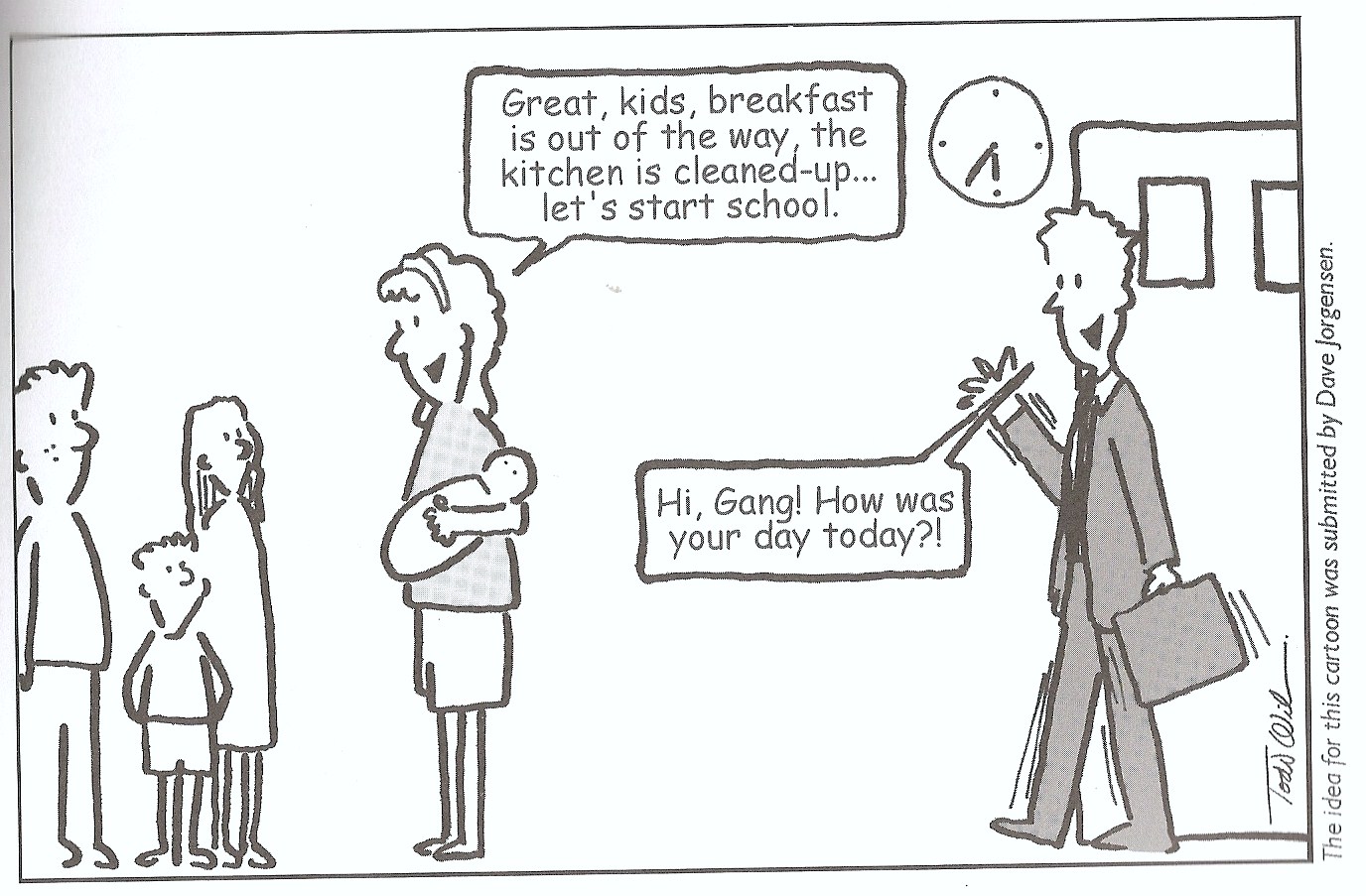 See Todd Wilson’s Family Man ministry, blog and hilarious books here.
I just learned of Michael Farris’ ongoing lawsuit defending the rights of a homeschool family to make difficult medical decisions on behalf of their children. This story involves some of my favorite issues: push back against the Nanny State, “experts” who upon examination prove to be more arrogant than informed, excellent lawyering, and Grand Rapids, MI. In his own words:
Who Makes the Really Tough Decisions: Parents? Or Doctors?
by Michael Farris
HSLDA Chairman
Who should make very difficult decisions for children? Parents or doctors?
In March of this year, 8-year-old Jacob Stieler was diagnosed with Ewing Sarcoma, a dangerous bone cancer. His parents took him to a highly-rated children’s oncology center in Grand Rapids, Michigan.
Jacob had surgery to remove the tumor, which was followed by several rounds of chemotherapy. The treatment was incredibly difficult, and Jacob’s mom, Erin, told me that when she looked her son in the eyes, she knew in her heart that he simply could not survive many more rounds of these drugs.
Erin and Ken, Jacob’s mom and dad, joined by hundreds of others, prayed for Jacob and his complete recovery.
After all of these rounds of chemotherapy were completed, there was a PET scan done to check on the status of the cancer. There was no evidence of cancer detected in Jacob’s body. Jacob’s family and friends rejoiced in his healing—praising God for this wonderful outcome.
But the doctors wanted to give Jacob several more rounds of chemotherapy and radiation, despite the clean PET scan. When asked why they wanted to keep giving Jacob these incredibly dangerous drugs, the doctors replied that this was “the standard of care” for his illness.
Jacob’s parents begged the doctors to make an individual diagnosis, rather than simply following unbending standards. But the doctors were steadfast. All children with this cancer needed multiple rounds of these drugs—regardless of PET scan results, the doctors contended.
Jacob’s parents did extensive study of the side effects of the five different chemotherapy drugs that the doctor wanted to administer. And they believed that the risk of the drugs was far greater than the risk of recurrent cancer, since Jacob had a clean PET scan. They said no to the doctors. No more chemotherapy treatment for now.
But the doctors would not take no for an answer. They called child protective services in Jacob’s county and asked the agency to file charges against the family for medical neglect.
After looking into the matter, both the local CPS agency and the local prosecuting attorney refused to file charges. They believed that the parents were making reasonable decisions for Jacob.
The doctors still would not take no for an answer. They called higher authorities in the state level CPS agency. The doctors had to make several calls before they finally found someone who would agree with them.
As a result of all of these calls, the local CPS agency was pressured into filing medical neglect charges against the parents.
The local prosecutor still refused to take a case against the family, so the state level CPS officials hired an independent private lawyer to serve as the prosecutor against Ken and Erin Stieler.
A jury trial is scheduled for early January to determine if the doctors will be given the authority to take over the medical decision-making for Jacob.
When I heard about this case—and checked out the facts—I knew that I could not sit on the sidelines and watch this family be overrun and parental rights be trashed by well-meaning but overzealous doctors.
I recently flew to Michigan and took the depositions of all three doctors who were scheduled to testify against the family.
Jacob’s treating physician is the key.
I prepared for the depositions by obtaining copies of the official “package inserts” that the FDA requires all drug companies to give to physicians and patients. Undoubtedly, you have seen these inserts when you have picked up prescriptions for your children.
The inserts tell you several things:
Kate Bolick created a bit of a buzz with her recent article “All the Single Ladies” published in Atlantic Magazine. Through this long and data-filled narrative, Ms. Bolick argues the modern feminist case against traditional marriage and family roles and justification for the sexual “revolution.” Ms. Bolick is a talented writer and thinker and interweaves her personal narrative through her polemic against traditional female roles. In fact, the candor of her narrative keeps the reader turning the pages. But through her candor, Ms. Bolick raises serious doubt about just how good this “modern” feminist ethics has been for women.
Ms. Bolick embodies the modern feminist lie life – pursuing self and professional fulfillment at the expense of marriage and family. She is talented, successful, attractive. She’s reached the top of the professional and social fields in New York City. By any “modern” feminist standard, Ms. Bolick is accomplished. She has more former boyfriends than she can recall.
But no love. No family. No children. At no point does she attempt to persuade that her choices brought happiness or fulfillment. Doubt, not happiness, pervade her writing.
In reviewing this illuminating essay, Maggie Gallagher observes,
Who exactly are the new enemies of Eros?
Sex has been divorced from meaning. Men are not being raised to be good family men, and women are not being raised to appreciate good family men. And men are failing to become the kind of men women want. Porn is available for all as a substitute for life.
So Kate, facing a future without children or marriage, wants to celebrate singleness and to kill her youthful idealization.
“Everywhere I turn, I see couples upending existing norms and power structures,” she says, citing a friend who fell in love with her dog walker, a man 12 years younger, with whom she stayed for three years “and are best friends today.”
Well, everywhere I turn in Kate’s essay I see women doing the best they can to celebrate the best they feel they can get, and it’s unbearably sad.
The truth is celebrating singleness—i.e., celebrating “not doing something”—makes no sense. Loving is better than not loving. Choosing to love and commit to a husband or a child is a much higher ideal than choosing not to; that’s why it needs to be celebrated and idealized.
Of course, not everyone marries or becomes a mother, and of course every human life has other possibilities for meaning, and other forms of love to give.
But all of these other loves—the aunt, the grandparent, the best friend—came into being because somewhere some woman gave herself to the independence-shattering act of making a family.
See Maggie Gallagher The New Singleness
Mona Charen commented:
There is a great deal of interesting data in this piece. According to the Pew Research Center, 44 percent of Millennials and 43 percent of Gen Xers think marriage is becoming obsolete. As of 2010, women held 51.4 percent of all managerial and professional positions, compared with 26 percent in 1980. Women account for the lion’s share of bachelors and masters degrees, and make up a majority of the work force. Three quarters of the jobs lost during the recession were lost by men. “One recent study found a 40 percent increase in the number of men who are shorter than their wives.” Fully 50 percent of the adult population is single, compared with 33 percent in 1950.
…
The resulting decline of marriage has been a disaster for children, a deep disappointment to reluctantly single women and unhealthy for single men, who are less happy, shorter-lived and less wealthy than married men. The sexual revolution has left a trail of destruction in its wake, even when its victims don’t recognize the perpetrator.
See Charen, Blame the Sexual Revolution, Not Men
At about the same time Ms. Bolick was making headlines, there was another, shorter story in the news, a counter-narrative to Ms. Bolick. This story was about traditional marriage. It was not filled with data and in-depth analysis. The story was about Norma and Gordon Yeager. They were not nearly as attractive or successful as Ms. Bolick. They were from Marshalltown, Iowa. In the eyes of the world, they were until recently entirely obscure.
Mr. Yeager had promised his wife he would never leave her. In late October, the Yeagers were in a car accident. Rushed to the hospital, they lay side by side in critical condition, holding hands. Mr. Yeager died, still holding his wife’s hand, with their family around them. Though dead, his monitor still indicated a beating heart. It was his wife’s heart picked up through their holding hands. An hour later, she died, still holding his hand. Mr. Yeager was 94; Mrs. Yeager was 90. They had been married 72 years together. The Yeager’s son said, “They just loved being together. He always said, ‘I can’t go until she does because I gotta stay here for her.’ And she would say the same thing.”
The Yeager’s testimony on marriage, love and family is compelling. RIP
As more generations continue to eat the poisonous fruits of the “sexual revolution,” we can only hope and pray that the old becomes new again.
This is an important article for all parents and is not specifically related to homeschooling. I highlighted some of the important points below:
Having self-centered dreams:
It is only natural for parents to have high hopes and dreams for their children. However, when we begin to see our children as a reflection or validation of us, we become the center of our dreams, and the children become our source of significance. When that happens in our home it affects the way we relate with our children, and subtly breaks down relationship.
Raising the family as an idol:
When we allow the success of our family to determine our security or sense of wellbeing we are seeking from it something God intends us to receive from Him. I am describing idolatry.
Tending to judge:
When pride is working its work in us, we sincerely believe our personal opinions reflect God’s utmost priorities and standards.
Over-reliance upon sheltering:
Sheltering is a critical part of parenting, but if parents keep it their primary focus, the children will grow up ill equipped to handle the temptations in the world.A child isolated from disease may appear to be of the greatest health to his parents, but the health of the human body is only proven by how it withstands an attack. A weak constitution succumbs to every germ and virus – a strong one fights them off. Our spiritual and moral health is developed and proved in the same way.
Conclusion:
I am convinced that the most contagious parenting is living a heartfelt faith before your children. Fruitful interaction is not about what you do to your young people, but who you are with them. It’s about having a real faith in God, and expressing it in a real relationship with a real person–not about methods and self-working principles. God intends that the side-effect of loving Jesus and enjoying the grace of the gospel will be that all people–including our children–will be touched by the Savior in us.
I encourage you all to read the entire article here.
RALEIGH–The North Carolina State Senate voted yesterday to concur with a bi-partisan vote in the North Carolina State House to pass a Marriage Protection Amendment recognizing marriage as the legal union of one man and one woman. The Senate passed the Amendment 30-16, while the House vote was 75 to 42. Passage of the Marriage Protection Amendment by both houses of the General Assembly allows the issue to go to a vote of the people on the next primary election ballot scheduled to be held May, 2012.
If a majority of North Carolina voters support the Marriage Amendment in this referendum, the language of the amendment will be permanently included in the North Carolina Constitution, and North Carolina will join thirty other states that have protected marriage in their constitutions.
“This is a great day for the people of North Carolinato be able to vote on this important issue,” said Tami Fitzgerald, Executive Director of the N.C. Values Coalition. “The voters have waited for eight years to vote on protecting marriage, and the General Assembly has finally provided that opportunity to them.”
The floor debate in the Senate included discussion of the economic advantages the Marriage Amendment would bring toNorth Carolina. States that have protected marriage have better business rankings than states that have not or states that have redefined marriage. “Whether it’s Forbes magazine, the American Legislative Exchange Council, CNBC, Chief Executive Magazine or the National Chamber of Commerce, the overwhelming majority of the states in the top ten in economic performance in the country are states that protect marriage in their constitutions,” Fitzgerald said.
The Marriage Amendment will also protect private businesses by allowing them to continue to offer benefits according to their own strategic business decisions instead of government mandates.
The North Carolina Values Coalition has worked since February toward passage of the Marriage Protection Amendment and expects to play a key role in the campaign to get it passed on the next primary ballot. Citizens interested in getting involved and supporting the NC Value Coalition’s efforts on behalf of marriage should go to NCValues.org
Categories
Choose Life from NC DMV
|
“Choose Life NC” Now Available |

| Here is a quick and easy way to provide resources for women with an unplanned pregnancy: The application form for the “Choose Life” plate is available HERE for download.
To apply for the “Choose Life” plate you must fill out the application form and return it along with the applicable fee ($25 for a regular DMV-issued “Choose Life” plate or $55 for a four-character personalized “Choose Life” plate) to the Carolina Pregnancy Care Fellowship (CPCF) at P.O. Box 3888, Charlotte, NC 28278. The DMV requires a third party-in this case the CPCF-to collect the initial 300 applications and fees. Once the CPCF submits all the applications to DMV, the plates will be made and sent to applicants. After the 300 threshold has been met, new applications for the “Choose Life” plate should be directed to the DMV directly. This specialty license plate will cost drivers that opt to purchase the plate an extra $25 per year for the DMV issued “Choose Life” plate or an extra $55 per year for a personalized “Choose Life” plate. This fee is in addition to the regular DMV vehicle registration fee. Of the additional $25, $15 goes to the CPCF, a nonprofit group that will distribute the funds to the state’s Pregnancy Resource Centers (PRCs). PRCs are non-profit, pro-life organizations located around the state that provide compassionate alternatives to abortion and help for women facing unplanned pregnancies, including counseling and other free-of-charge services. |
“Our very nature demands home. It is the first essential element of our social being. This cannot be complete without home relations. ” John Potts
One of the best fringe benefits of practicing intellectual property law is meeting creative and innovative people. Several years ago I was blessed to receive a call from Vicky West, who with her daughters went by the name The West Girls. They needed help copyrighting their new album, Further Along, which they independently produced and wrote most the songs from their remote holler somewhere in the back hills of Tennessee. I quickly realized that not only was the album independently produced, the family itself is simply independent — self-sustaining (in the temporal sense) and off the grid — four miles from the nearest power line! Their album is simply great blue grass and is available in CD directly from them and via download through Amazon. Greenbeans in the Garden is one of my family’s all-time favorite songs. (It appears that when they’re singing about greenbean gardens, they know what they’re talking about – see here.) There’s not a bad song on the album; the entire album is a favorite of mine. I understand that they may be soon releasing their second album … Can’t wait to hear it.
The West Girls, now more commonly known as The West Ladies, have also been involved with several other productions under their label Homestead Blessings, such as a multi-part DVD series on valuable homemaking skills, including instruction in bread making, candle making, soap making, canning, gardening, herbs, cooking, dairy, and sewing.
In 2003, the Massachusetts Supreme Judicial Court ruled that barring same-sex couples from civil marriage was unconstitutional. In an advisory opinion to the state legislature on why enacting “civil unions” as an alternative to marriage was legally insufficient, the Court explained its view that “segregating same-sex unions from opposite-sex unions cannot possibly be held rationally to advance or preserve” the governmental aim of encouraging “stable adult relationships for the good of the individual and of the community, especially its children.” Under this decision, the state of Massachusetts began issuing marriage licenses to same-sex couples in May 2004. Over the next seven years, activist courts across the country continued to rule that the failure or refusal to extend “marriage” to gay couples violated state and the federal constitution. See here.
Polls show an ever increasing number of Americans support the notion of gay marriages, demonstrating yet again the normative influence of laws over time and the power and consequence of an activist judiciary. See here.
This past June, the New York legislature was the first body of elected officials to pass a gay marriage statute on its own volition.
Two leading conservative evangelicals point the blame for this unbiblical re-defining of marriage not on the activist courts or the politicians, but instead on the Church. Ken Ham observes of the NY gay marriage law, “This is only the latest in a long list of how America has been turning its back on biblical authority.” See here. Mr. Ham points out that the church and Christian leaders have so compromised God’s word and failed to teach apologetics and that faith that the current generations are simply walking away from the faith and Biblical truth is increasingly ignored. Mr. Ham explains and demonstrates these points at the church and Christian college level in his two recent books Already Gone and Already Compromised.
In a recent interview with Charisma News, Dr. Michael Youssef expressed a similar sentiment:
Younger evangelicals have been sucked in by false teaching and are now walking away and turning their backs on biblical morality. The only morality they look at is taking care of the poor by the government—not by us but by the government. That is very dangerous. …
This problem started in the church. The society did not begin to collapse on its own, morally, when churches started to reject the authority of the word of God. The debate about homosexuality started in the church and not politics. The Episcopal Church started the whole thing by ordaining gays and blessing gay marriages. That came from the church pulpit into society. Then the Presbyterians followed and now many evangelicals don’t want to talk about it. The main issue is rejecting God’s word as authoritative over us as individuals and as a church. As goes the church so goes society. The church is the one that needs to repent first. It is my call to the church … to call the church to repentance. Until that happens society is going to continue going in a downward spiral.
Alan Sears recently wrote in American Thinker that the church’s morale failure has been by design, which would make repentance of the church even more difficult:
The church survived intact until late in the 20th century, when the leftist onslaught changed from “in your face” to “in your place,” and activists of every stripe pursued the pulpit in order to further their various causes. (Thus, certain churches are often accomplices in things like the homosexual agenda instead of an impediment to it.) Thus, rather than calling the culture to repentance in light of biblical truth, churches increasingly reflected the culture, actually providing a degree of spiritual comfort for all sorts of behavior.
Mr. Sears sees the church’s being encroached by the dollar and by government.
At CatholicCulture.org, Dr. Jeff Mirus recently explained why homosexuality may provide the impetus for the next gulag.
No group is more hateful to modern society than the perceived moralistic prigs who, out of what most perceive as religiously-motivated prejudice, seek to diminish the personal sexual liberty of others. Nothing could be more obvious in our current culture than that such people must be silenced and, if necessary, restrained. Moreover, it seems only right and just that their denunciation of the gay lifestyle and their opposition to gay marriage should be criminalized. In fact, it should be criminalized in the name of liberty. That is why gay marriage is the lie that will create the next Gulag.
Dr. Mirus concisely explains how we’re following the logical path of “sterile” marriages, i.e. where reproduction is no longer the central focus of marriage and sex. The path started with divorce and then to birth control, abortion, homosexual marriage and increasingly suppression of opposition. There is increasing evidence of a future where standing for Biblical truths will result in criminal and professional punishment. Dr. Mirus advises that we are to live the Truth of Christ in our lives and in our families in the days to come, particularly in the face of persecution.
The prospect of criminal and professional persecution of those who espouse or practice Biblical truths is not terribly far fetched or far off. Indeed, my State Bar of NC recently tried to prohibit its licensed attorneys from taking taking sexual orientation, transgender, or sexual identity issues into consideration during the course of practicing law, such as when hiring new attorneys or deciding whether to represent a client.
Not only are Baby Boomers leaving future American generations with trillions of dollars of debt to repay, but these sexual Bolsheviks appear intent on establishing Pink Fascism as part of their legacy. Pray hard for repentance and revival.
Categories
Friends Forever
Excellent article by Michael Hyatt on how to become your spouse’s best friend. He recommends the following very simple three step process:
1. Make a list of what you would want in a best-friend.
2. Now become that person for your spouse.
3. Keep sowing the seeds, until the relationship blossoms.
Please read the entire article: How to Become Your Spouse’s Best Friend
Categories
Only a Dad
Only a dad with a tired face,
Coming home from the daily race,
Bringing little of gold or fame
To show how well he has played the game;
But glad in his heart that his own rejoice
To see him come and to hear his voice.
Only a dad with a brood of four,
One of ten million men or more
Plodding along in the daily strife,
Bearing the whips and the scorns of life,
With never a whimper of pain or hate,
For the sake of those who at home await.
Only a dad, neither rich nor proud,
Merely one of the surging crowd,
Toiling striving from day-to-day,
Facing whatever may come his way,
Silent whenever the harsh condemn,
And bearing it all for the love of them.
Only a dad but he gives his all,
To smooth the way for his children small,
Doing with courage stern and grim
The deeds that his father did for him.
This is the line that for him I pen:
Only a dad, but the best of men.
Edgar Guest
THANKS DAD! HAPPY FATHERS DAY!
 Sapphire Sky