Categories
encouragement theology

The Garden

file0001578227386

The garden.

Gethsemane.

There were moments in the life of Jesus Christ when he suffered greatly, but this was total agony!

Here, in the garden, is the greatest struggle that Jesus will face. He will endure hardship, torture, and death at the hands of men on the way to the cross. But there was no struggle as he went to his death. The great struggle for Jesus Christ was here in the garden, in Gethsemane.

At the beginning of his ministry, Jesus said, “my food is to do my Father’s will” (see here). But now the horror of the cross draws near and it terrifies Him! It is not the physical pain that Jesus Christ fears, but the separation from His Father. He, the one who knew no sin, will take upon himself the guilt of all the sins of the world!

Jesus contemplated his upcoming death on Tuesday. The thought about what he was going to suffer horrified him, but Jesus refused on Tuesday to ask the Father to save him (see here).

But now it is Thursday night. The horror is so intense that Jesus struggles in anguish. He drops to his knees. He falls to the ground. He picks himself up, only to fall again. His blood vessels burst, and the blood mixes with sweat. God the Father sends an angel to comfort Him and keep Him alive.

Jesus refused to pray for deliverance on Tuesday, but now He asks for it three times! “My Father, if it be possible, let this cup pass from me!” He cries out to the father was a plea of a child, “Abba, father!” That is to say, “Daddy help me!”

You may have seen the popular pictures of Jesus in the garden. In the pictures, Jesus is gently kneeling next to a large boulder with a serene look on his face. A ray of light illuminates Jesus and the ground around Him. Jesus looks sorrowfully and wistfully at the sleeping disciples in the background. In some pictures, He even has a halo on his head.

The true picture of Jesus Christ in the garden is anything but placid and serene. The Lord Jesus Christ, the Son of God, is subjected to more suffering and conflict in that garden than we will ever understand. His struggle is filled with stumbling and falling, with loud wailing and tears, and sweat that was mixed with blood!

Hebrews 5:7
In the days of his flesh, Jesus offered up prayers and supplications, with loud cries and tears, to him who was able to save him from death, and he was heard because of his reverence.

Gone is the eloquent prayer that He prayed as He left Jerusalem (see here). Matthew and Mark show that Jesus was filled with dread as He approached the garden. He left eight of His disciples and continued deeper into the garden with Peter, James, and John. He then left those three and continued on alone.

He commanded His disciples to “watch and pray”. If there was a time when He needed companions, it was now. But as He goes on alone, the weariness and the sorrow of the day have taken their toll on the disciples. They fall asleep. Jesus is alone.

After struggling in prayer for an hour, Jesus returned to His sleeping disciples. He woke them up and rebuked Peter, “Couldn’t you watch with me for one hour?” He then warned the disciples to be alert and pray so that they do not enter into temptation. He knew that they wanted to follow Him, but they didn’t know their own weakness. “The spirit indeed is willing, but the flesh is weak.”

Jesus returned to His struggle in prayer, only to come back to find the disciples sleeping again. Leaving again, He returned for a third time into the garden to pray. His prayer is now complete and the struggle has ended. He returns to the sleeping disciples.

The time for sleep has come to an end. The time for prayer has ended. The enemy is at hand.

“But in that night the fierce wind of hell was allowed to sweep unbroken over the Saviour, and even to expend its fury upon those that stood behind in His Shelter.” – Alfred Edersheim [5]

“He disarmed Death by burying his shaft in His own Heart.” – Alfred Edersheim [5]

“The whole of the tremendous debt was put upon his shoulders;
the whole weight of the sins of all his people was placed upon him.
Once he seemed to stagger under it: ‘Father, if it be possible.’
But again he stood upright: ‘Nevertheless, not my will, but thine be done.’
The whole of the punishment of his people was distilled into one cup;
no mortal lip might give it so much as a solitary sip.
When he put it to his own lips, it was so bitter,
he well nigh spurned it—’Let this cup pass from me.’
But his love for his people was so strong, that he took the cup in both his hands, and
At one tremendous draught of love He drank damnation dry, for all his people.
He drank it all, he endured all, he suffered all;
so that now for ever there are no flames of hell for them, no racks of torment;
they have no eternal woes;
Christ hath suffered all they ought to have suffered, and they must, they shall go free.”

– C. H. Spurgeon [9]

Previous post: The Lord’s Prayer

Categories
encouragement theology

The Lord’s Prayer

sun-203792_1280

We know that Jesus spent a lot of time in prayer to the Father.

He spent all night in prayer before choosing the 12 apostles (see here).

As his popularity grew, he would withdraw to desolate places to pray (see here).

He spent at least nine hours in prayer before coming down to rescue the struggling disciples on the Sea of Galilee (see here and here).

We know that Jesus spent a lot of time in prayer, but we have only brief excerpts of his words. John 17 has the longest recorded prayer from Jesus Christ, and it shows His heart as he comes to the Father on behalf of his disciples.

What does Jesus Christ pray for?


He prays for his glory

First, he prays for his glory. As the cross is rapidly approaching, Jesus is comforted by the fact that the cross will bring glory to Him and to God the Father (see here). He also looks past the cross to when He will return to the Father. Jesus Christ has been the focus of total glory and honor since before the world began. He now looks ahead to his return to glory with the Father.

It is all about God’s glory. Jesus is about to endure the agony and the separation of the cross, yet he looks forward to the glory that will come through it. With this in view, Jesus says, “It is time. Let it come.”

1 Peter 3:18,22
For Christ also suffered once for sins, the righteous for the unrighteous, that he might bring us to God, being put to death in the flesh but made alive in the spirit, … who has gone into heaven and is at the right hand of God, with angels, authorities, and powers having been subjected to him.

Colossians 3:1
​If then you have been raised with Christ, seek the things that are above, where Christ is, seated at the right hand of God.


He shows a new relationship with God

Jesus showed the world a different relationship with God. Faithful Jews throughout the Old Testament knew of God as someone to be revered and worshipped, but Jesus introduced something new. Never before in history had anyone addressed God as “Father”.

We need to revere and worship God, yet we can also know Him closely. We can have a close relationship with Him so that we ourselves can call him Father.

There is a special significance to the name of God. In the Jewish culture, the name of a person meant much more than simply a way to identify him. A person’s name expressed the nature and character of that person. A man’s name was his essence. [5]

Romans 8:14-15
For all who are led by the Spirit of God are sons of God. For you did not receive the spirit of slavery to fall back into fear, but you have received the Spirit of adoption as sons, by whom we cry, “Abba! Father!”


He prays for His own – “Father, keep them”

Jesus prays for His own. These are the eleven disciples who are standing with him. Jesus recalls the following about them:

  • The Father gave them to him out of the world
  • They believed the words of God
  • They obeyed God
  • They know that Jesus Christ was sent by God the Father
  • They know that Jesus Christ was empowered by God the Father
  • Jesus taught them the Father’s character (his name)

God the Father had given these eleven disciples to Jesus Christ. But His own are much more than these eleven. This prayer and these promises are for all who have believed in Him. We became part of His own when we believed in Jesus Christ.

Jesus asks the Father to preserve us. He does not ask on behalf of the world that is rebelling against God, but he asks to preserve the believers who live in this world.

Remember again who is preserving us. We are being preserved based on the character and nature of the Holy God. Jesus kept every one of his disciples when he was on earth, and now he has committed us to the Father.

None of Jesus’ disciples were lost except for Judas, who never had believed in Him (see also here).

He left us this promise that the Father will keep us. We will not be lost. Through this promise we can have complete joy, even in severe trouble (see also here).

“But He says…I’m leaving. I’m leaving and the glory display of My presence and their surrounding that presence will change and they will remain. O Father, keep them.” – John MacArthur [5]

John 10:27-29
My sheep hear my voice, and I know them, and they follow me. I give them eternal life, and they will never perish, and no one will snatch them out of my hand. My Father, who has given them to me, is greater than all, and no one is able to snatch them out of the Father’s hand.

Romans 8:38-39
For I am sure that neither death nor life, nor angels nor rulers, nor things present nor things to come, nor powers, nor height nor depth, nor anything else in all creation, will be able to separate us from the love of God in Christ Jesus our Lord.


He prays for His own – “Father, set them apart”

Believers in Jesus Christ are left in a world that is hostile to God and hates any who represent Him. Jesus does not pray for us to be taken out of this world, but that God would protect us through this world. His prayer is to protect us from the devil.

Jesus prays that God would sanctify us in this world. Literally, the word “sanctify” means to “set apart”. The truth of God’s word sets us apart from this world. We are in this world, but we are set apart to be used for God’s special purpose.

Ephesians 1:3-4
Blessed be the God and Father of our Lord Jesus Christ, who has blessed us in Christ with every spiritual blessing in the heavenly places, even as he chose us in him before the foundation of the world, that we should be holy and blameless before him.

2 Thessalonians 2:13-14
But we ought always to give thanks to God for you, brothers beloved by the Lord, because God chose you as the firstfruits to be saved, through sanctification by the Spirit and belief in the truth. To this he called you through our gospel, so that you may obtain the glory of our Lord Jesus Christ.


He prays for His own – “that they be one”

Jesus prays for all believers, that we be one. We have different cultures and different gifts, but we have a common Father. We are kept and set apart by the same God. We have the same hope, that we will be reunited with Jesus Christ.

Jesus prays three times that “they be one even as we are one”. Our unity is patterned after the unity of the Father, the Son, and the Holy Spirit. We are united because we have the Father, the Son, and the Holy Spirit dwelling in us.

We are given close fellowship with the Holy God. As we have this close fellowship with God, we will be united with the other believers in Jesus Christ who share this same fellowship with God.

One of the results of our unity is that we show Jesus to the world. We show the world that Jesus is from God and that we have the love of God.

In the second century, Tertullian wrote that even the heathen exclaimed with admiration, “Behold how these Christians love one another.” [9]

1 Corinthians 12:12-13
For just as the body is one and has many members, and all the members of the body, though many, are one body, so it is with Christ. For in one Spirit we were all baptized into one body—Jews or Greeks, slaves or free—and all were made to drink of one Spirit.

Ephesians 4:4-6
There is one body and one Spirit—just as you were called to the one hope that belongs to your call— one Lord, one faith, one baptism, one God and Father of all, who is over all and through all and in all.


He prays for His own – “that they be with me”

Jesus prays that we would be with Him. When we are with Jesus, we will see his glory. As Jesus promised earlier (see here), He will come back for us. We will be with him for eternity.

2 Corinthians 5:6-8
So we are always of good courage. We know that while we are at home in the body we are away from the Lord, for we walk by faith, not by sight. Yes, we are of good courage, and we would rather be away from the body and at home with the Lord.


Remember!

Jesus brought these requests to the Father before he finished his time on earth. These are not goals for us to achieve, but requests to God on our behalf. We know that all prayers by Jesus Christ are answered (John 11:42), so we can be sure that these have been done!

We know that the Lord Jesus Christ has returned to Heaven and is seated on the right hand of God the Father.

We know that we have a new relationship with God – he is now our father!

We know that the Father will keep us — nothing will separate us from him!

We know that the Father has set us apart — we are separate from this world and holy to Him!

We know that we are one in Jesus Christ — we all are one body!

We know that when we leave this mortal body, we will be with Jesus Christ!

Jesus did not pray for our action. All action in this prayer is by God the Father.

This prayer is not for what we will do. This prayer is for who we are!


Previous Post: Just a little while longer

Categories
encouragement theology Uncategorized

Just a little while longer

Koksan gun barrel
This will not be easy.

We can easily get caught up in our current events. Hatred is an all-time high. Biblical morals are at an all-time low.

Americans are vocally showing their hatred for Christians and anything different from them.

Religious zealots around the world are looking to kill and destroy Christians and anything associated with them.

Our government often acts like it is paralyzed. At best, it is doing nothing. At worst, is the cause of the problems.

These thoughts were written almost 70 years ago. This was from a pastor in the 1940’s. [3]

Two other teachers also shared the exact same thoughts. One taught this same message in the 1970’s [6] and the other in the 1990’s [1].

Jesus promises that the world will hate us. The world’s system of belief has been set up by the devil and will always be opposed to Jesus Christ.

During his final time of teaching, Jesus has used the most personal and comforting words to encourage his terrified disciples.

He gave encouragement:

  • He will be glorified (magnified) and God the Father will be glorified in him (John 13:31-32, see here).
  • He will come back for us like a bridegroom returning for his bride (John 14:1-4, see here).
  • He is the only way to God (John 14:5-7).
  • He will send the Holy Spirit. The Holy Spirit will teach us, guide us, and will never leave us (see here).
  • He will answer our prayer (John 14:13-14; John 15:16; John 16:23-24).
  • He gives us a peace that is beyond anything the world can offer (John 14:27).

He left instructions:

He also warned Peter that he did not know his own weakness (John 13:36-38). But there is a greater warning for all of us.

We are to abide in Him and to love each other because the world will be our enemy.

Jesus never promises an easy life. The world will hate those who claim Jesus Christ as Lord. They hated Him and they will hate us when we represent Him.

The world will hate us because we are not part of this world.

The world will hate us because we show them that they are guilty. Jesus came to earth almost 2,000 years ago and they rejected Him. Even today, people still refuse to believe in Jesus Christ.

The Holy Spirit within us will show Jesus Christ to the world. He will show people their sin of rejecting Jesus Christ. He will either convince them or judge them (see here).

Followers of Jesus will be thrown out social, political, and religious circles. Just like Saul in the New Testament (see here), they will kill Christian men and women, thinking that they are serving God by killing them.

Jesus says, “Remember that I told you, it will get rough”.

So how can we respond to this?

It is popular to curse the darkness. Should we fight back?

Should we live in fear?

Jesus takes the last part of his final sermon to tell his disciples how to respond. These words for them are just as appropriate today. The threats may have changed since Jesus’ day, but the same devil controls the people of the world today as he did 2,000 years ago.

Jesus tells us the following:


Leave them to the Holy Spirit

The Holy Spirit will convict the people who do not believe in Jesus Christ. As discussed here, the Holy Spirit will show each man and woman the truth about Jesus Christ. It is the Holy Spirit who will convince those who believe, and it is the Holy Spirit who will pass judgment on those who refuse to believe.

It is not for us to personally convince people of Jesus Christ. We need to stay close to Jesus Christ and let the Holy Spirit work through us.


The sorrow is temporary

Jesus was arrested, tortured, and executed while his enemies celebrated. Yet the Roman cross — the instrument of His execution — is our cause for joy. We can look back and see how God used the anguish and sorrow of the cross to defeat death and crush Satan. It is because of this cross that we have hope of life in Jesus Christ.

In the same way, the horrors and the sorrow that we experience today will someday cause us to rejoice. Like the pains of childbirth, Jesus promises that there will be a time when our pain will end and it will be replaced by joy.

2 Corinthians 4:16-18
So we do not lose heart. Though our outer self is wasting away, our inner self is being renewed day by day. For this light momentary affliction is preparing for us an eternal weight of glory beyond all comparison, as we look not to the things that are seen but to the things that are unseen. For the things that are seen are transient, but the things that are unseen are eternal.

Jesus promises that when he comes back, he will give us joy that no one can take away!

“Sorrow can crush us if we don’t view it as temporary, allowed, and designed for our spiritual growth.” – Stephen Davey [4]


We have direct access to God the Father

We are the friends of God (John 15:15-16). There is no longer any need for parables or figures of speech. We can learn directly about God. We can pray directly to God!


We will fail

It is comforting to know that Jesus predicted that his followers would all run away. They thought they had it all figured out, but they did not know the enemy who is against them.

Jesus knew that they would fail when he gave all of these promises. Not one of these promises were broken by their failure. There is nothing that we can do to break the promises of God!


“I have overcome the world”

We will have tribulation. Literally, this word means to “be pressed together”. We will have distress, affliction, anguish, pressure in this world, but Jesus is greater!

John 16:33
“These things I have spoken to you, so that in Me you may have peace. In the world you have tribulation, but take courage; I have overcome the world.”


Previous post: The Vine and the Branches

Categories
encouragement theology

The Vine and the Branches

grapes-694164_1280

This passage contains one of the simplest and one of the most well-known allegories of the Christian life: the vine and the branches.

The popular belief is that you need to behave well in order to be a good Christian. You get closer to God by acting better, doing good deeds, and being kind to other people. You then make God happy by how nice you have become.

Jesus teaches the complete opposite!

It was late Thursday night, on Jesus’ final night on earth. As he walked through the streets of Jerusalem with his disciples, the great temple would be in full view in front of them. A massive golden vine covered the top of the wall, with the grapes “as tall as a man’s height” (according to Josephus) [3].

In front of this backdrop, Jesus says, “I am the true vine.”

The great vine was the national symbol of Israel. God himself had used the vine to illustrate Israel, but they had turned away from God. Instead of showing God’s glory to earth, they had become a wild vine bearing useless fruit (see Isaiah 5:1-7 and Jeremiah 2:21).

Israel was supposed to be the means to bring people to God, but they failed. Israel was to showcase God’s glory, but they thought only of themselves. Unlike faithless Israel, Jesus is the true vine. Jesus is the way to God (John 14:6) and he brings glory to God (John 15:8).

All of us who have a relationship with Jesus Christ have a part in Jesus’ mission. He is the vine, the true vine, and we are the branches.

Our job – our essential job – is to abide in Him. As a branch stays in the vine, so we are to stay close to Jesus Christ. Jesus supports and gives life to his people in the same way that the vine supports and gives life to the branches.

Jesus never teaches that you should do good things to get close to God. He says the opposite – stay close to him and he will do the good things through us. This is beyond anything that we can do, and so God gets all of the credit!

Jesus makes several wonderful promises of what will happen when we abide in him.


We produce fruit when we abide in him. Jesus gives us permanent, tangible results when we stay close with him. This fruit in our lives may vary, but it includes repentance, good works, godly attitudes, wisdom, praise, and impact on others (see below for a more detailed list).

We are totally helpless to generate this fruit apart from Jesus Christ. We often think that our problem is that we are not trying hard enough. Jesus says to stop trying altogether. “Just abide in me!”

“We are not handicapped, we are paralyzed!” – Stephen Davey [4]


We will be pruned when we abide in him. He cuts out the empty parts of us so that we can produce more fruit. This pruning process can be painful, but God wants us to grow into a more fruitful branch for Him.

“And so when we have to pass through great trials, deep waters and many sorrows, it is not an evidence that He does not love us, that He does not care for us.” – H.A. Ironside [2]


He answers our prayers when we abide in Him. God never promises to answer our prayers when we are avoiding Him (Psalm 66:18). But when we abide in Him, we are able to pray from the very heart of Jesus Christ, asking what he himself would ask (see here).


We radiate the love of Jesus Christ when we abide in Him. We are anchored in the love of Christ and we show it by our love for others. We are no longer slaves, but friends of the Lord Jesus Christ! He demonstrated his love for us, as his friends, by giving his own life for us (see also Romans 5:8).

We keep Jesus’ commandments when we are anchored in His love by abiding in Him. It is no longer a duty to obey him but an act of love. We show our love to Him by loving His children.


We experience full joy when we abide in him. Jesus was only hours from dying on a Roman cross, yet he promised joy to his disciples! This joy is beyond happiness, and can survive through the worst of pain. How do we experience this joy? We experience this full joy when we abide in Him.

We experience this full joy when do what we were created to do – to glorify God!


Jesus gives one more promise in this section. Your time is limited if you do not know Jesus Christ. If you have never believed in Him, then you are as useless to Him as a branch that never produces grapes. You can pretend to be close to Jesus Christ, but take a warning from the useless branch. The destiny of the useless branch is to be thrown away, to wither, to be gathered, thrown into the fire, and burned.

If you have not believed in Jesus Christ, do not hesitate any longer! This may be your last chance to believe in Him (see here). Be warned, but come to him before you are thrown out like the useless branch.

If you have believed in Jesus Christ, abide in him. Abide in Him! Stay close to Jesus Christ and obey him out of your love for Him. All of the good deeds that you can do are useless if you do them apart from Jesus Christ.


Previous Post: The Holy Spirit

Categories
encouragement theology

The Holy Spirit

john-14-16
The New Testament says a lot about the Holy Spirit. In the book of Ephesians, we are told to be filled with (literally, “dominated by”) the Holy Spirit (Ephesians 5:18-21). The book of Galatians contains the famous passage about living in the Spirit and the fruit (effects) of The Spirit (Galatians 5:22-23).

But what did Jesus say about the Holy Spirit? Up to this point, Jesus has taught extensively about God the Father and God the Son. As seen in John 5, the Father and the Son are totally equal and abide together in total intimacy.

But Jesus has not taught directly about God the Holy Spirit until now. He alluded to the Holy Spirit in John 3 and John 7, but he did not directly teach about the Holy Spirit until he was ready to leave.

Jesus’ entire ministry was a living demonstration of the Holy Spirit. Jesus surrendered the use of his divine attributes when he came to earth. This included his omnipotence (being all-powerful) and omniscience (being all-knowing) (see here). He lived on earth with the same limitations of humanity, except that he had no sin (see here). He totally relied on the Holy Spirit for direction, knowledge, and power to perform miracles.

The Holy Spirit descended on Jesus Christ when he was baptized by John (see here). The Holy Spirit led Jesus into the wilderness, where he was tempted by Satan (see here). He gave him supernatural knowledge about the Samaritan woman (see here). Most notably, when the Pharisees accused Jesus of doing miracles by the power of the devil, Jesus condemned them for blasphemy against the Holy Spirit (see here and here). The miracles of Jesus were done through the Holy Spirit.

But now Jesus is leaving. He promises to send the Holy Spirit, the same person who enabled him through his ministry on earth. The Holy Spirit will come as a helper, one who will come alongside believers in this world.


Who is the Holy Spirit?

Who is the Holy Spirit?

Jesus also refers to Him as the Helper (also translated “comforter”) and  the “Spirit of Truth”.

The Holy Spirit is a person, not an impersonal force. The world does not know him, he dwells with you. He will teach you. …

The Holy Spirit is God. Jesus promises to send another helper, literally, “one who is exactly like me”. He will come from the Father.

The Holy Spirit will be with us forever. Old Testament saints knew that the Spirit of God would come upon people for a short time, but now he promises to stay with us forever!

The Holy Spirit will lead us to the truth. He is the Spirit of Truth. He is our divine teacher who will bring God’s Word to our mind, and will illuminate His Word so that we can understand it.

The Holy Spirit is unknowable to the unbelieving world. Those without Christ cannot see or know the Holy Spirit. By contrast, he will show himself to those who believe.

The Holy Spirit is in complete unity with God the Father and God the Son. The Father sends the Holy Spirit in the name of the Son.

The Holy Spirit will glorify Jesus Christ. The Holy Spirit reveals Him to those who believe. His ministry always points back to Jesus Christ.

“And he is the comforter. We often believe that the comforter is like a warm fuzzy blanket, but he is the strength that will give us the ability to stand against evil. He fortifies us with supernatural strength.” – Stephen Davey [2]


The role of the Holy Spirit with the unbelieving world

The Holy Spirit shows Jesus Christ, even to those who do not believe. He is the voice behind the persecuted Christians who tell of Jesus, even when it leads them to torture or death. The Spirit of Truth will bear witness of Jesus Christ.

The Holy Spirit will either convince or convict those who do not know Jesus. If He does not convince you to believe in Jesus, He will be the one to convict you. If he cannot persuade you, he will pronounce the sentence of eternal punishment.

He shows you your sin. If you do not believe in him, your unbelief will be the one sin that condemns you (John 3:18).

“… the outstanding sin which will separate you from God forever will be that you rejected the Savior whom He has provided.” – H.A. Ironside [6]

He shows you the standard of what it means to be “righteous”. There was only one perfect person — Jesus Christ! Jesus defeated death and is now with God the Father. He sits with the Father in complete perfection.

He shows you your ultimate destiny if you do not believe. Satan, the ruler of the world, is already judged. Those who refuse Jesus Christ will face judgement with him.

“If Jesus Christ swung the death blow at Satan and hit dead center, you don’t think that someone less than Satan is going to get away. When Satan was judged, every man and every angel that ever attached himself to Satan was damned with him.” – John MacArthur [5]


The role of the Holy Spirit with believers

Jesus tells his 11 terrified companions that this is to their advantage that he leave them. Why?

What could be better than living with God himself? They had spent over three years with him!

How can this be an advantage?

Jesus was limited by his human body. While Jesus was in one place on earth, the Holy Spirit can be everywhere. While Jesus was with some believers on earth, the Holy Spirit will be in all believers.

The Holy Spirit teaches wherever God’s Word is present. When Jesus taught in one city, the next city was not able to hear the Word of God. Without the Holy Spirit, the Gospel could never spread across the entire world.

The Holy Spirit gives understanding. The disciples could not understand what Jesus did and what He taught. They needed the Holy Spirit to give them understanding (John 12:16).

Below is just a sampling of the many ways that the Holy Spirit works in the lives of believers [4]:

“He opens up the riches of grace and love, and gives us to know the wealth of the realm over which Christ is set and which we are to share with Him.” – H.A. Ironside [6]


Previous Post: I Am Returning to the Father

Categories
encouragement theology

I Am Returning to the Father

john-14-2

It is late Thursday night, and Jesus has just finished the Passover dinner with his disciples. He showed them humility by washing their feet. He told them that there was a traitor among them. During their time of astonishment, the traitor, Judas, left.

The events are now in motion. By the next morning, Jesus will be taken away to die on a Roman cross.

But Jesus needs to prepare his struggling disciples. He is going to leave and they cannot come. Jesus was their entire life for the last three years, and now he will be gone! They are still struggling with the thought that one of the disciples would betray him, and this new news must have been too much to bear!

What follows is one of the most touching and heartfelt conversations between Jesus and his disciples:


“I am leaving and you cannot come”

These events will lead to God’s glory. Before anything else, God’s glory is most important!

He will crush the power of sin and death.

God will show his justice, faithfulness, mercy and love by letting his own son die for the entire world!

Jesus will have the ultimate glory when he rises from the dead and returns to Heaven.

But what about the ones left behind?

What about his followers here on earth?

They are not left alone. We are not left alone. We have each other.

Jesus’ final command is to love each other. Regardless of background. He will repeat this command throughout this final conversation (see here).


Peter: “Why can’t I follow you? I would die for you!”

Peter is ready to follow his Lord Jesus to death! But Peter does not know his own weakness. When the time comes to be brave, Peter will be hiding like a coward, denying that he ever knew him!

He will do this three times.

It is easy to fall upon our own bravado. We belittle others’ failures and vow that we would have never done that if it were us!

But notice that this follows closely on Jesus’ command. We are to be known by our love — even when we fail!


“You will be with me for all eternity!”

Jesus gives some of the deepest words of encouragement in all of Scripture. He will no longer be physically present. But they needed to put their trust in an invisible God, and believe in him in the same way.

“Just as you have believed in the unseen God through the years, I want you to put your faith in Me, the unseen Christ, after I have gone back to the Father.” [7]

“Stop agonizing in your hearts. I am completely trustworthy.” [5]

Like a husband who is preparing a place for his bride, so Jesus is returning to the Father’s house to prepare a place for us. He will bring us back to himself and we will be with him for eternity!

“Let not your hearts be troubled. Believe in God; believe also in me. In my Father’s house are many rooms. If it were not so, would I have told you that I go to prepare a place for you? And if I go and prepare a place for you, I will come again and will take you to myself, that where I am you may be also.”


Thomas: “How can we know the way?”

Thomas speaks for the rest of the group when he says, “I don’t get it”. How can we know the way?

Jesus’ reply is direct.

“I am the way”. He is the way, the only way to God. He is not just giving directions, he will take us there himself.

“I am the truth”. He is the truth, the only truth. They know the Father because they know the Son. With him is truth. Apart from him, there is no truth.

“I am the life”. He is the life, the only life. There cannot be death in his presence (see here). There cannot be life apart from him.

He is exclusive. No one else can get to the Father except through Jesus Christ.

“Religion is worthless because it provides no way to get to heaven.” – John MacArthur [9]

“While many religions will try to take bad people and make them better, only one is qualified to take dead people and make them alive.” – Stephen Davey [8]


Philip: “Just show us the Father.”

Philip’s request is, “Please just give us something tangible.”

But we already know the Father when we know Jesus Christ. He is given us not one, but two tangible things: his words that he said, and his works that he did.

How often do we look something more from God when we should be relying on what he has already given us!


“You will do greater things. Ask in my name and I will do it.”

Jesus showed the Father when he was on earth. Now that he is returning to the Father, he will enable us to do even greater things.

We reflect God the Father to our broken world.

We pray from the heart of Jesus Christ himself, asking to fill what he wants. We pray for God’s glory. We pray to love one another. We pray that our joy may be full. He promises to give us what we ask.


Previous post: It Was Night.

Categories
encouragement theology

It Was Night

weather-768460_1280

It is an awesome responsibility to teach or to lead another person. Whether you are in the role of a parent, a teacher, or a mentor, it is a great privilege to teach another.

But what do we do when things go wrong? What do we do when a student turns away from what they have learned? When they reject the teacher? We can blame ourselves, but we cannot change another person’s decisions.

You could be a perfect teacher, and yet some would still turn away. The best teacher who ever walked on the earth had a student walk away from him.

That student did more than turn away from him. He turned him in to the authorities to be arrested, tortured, and then executed.

Jesus had intensely taught his disciples for three and a half years. They all saw him teach, work miracles, and raise the dead. Each of them were able to teach and do miracles themselves. Eleven of them would follow Jesus to their own death, yet one refused to believe.

Jesus was at the final Passover dinner with his disciples when he became greatly disturbed. To the shock and amazement of everyone in the room, Jesus announced, “One of you will betray me!”

The traitor had hidden himself so well that no one suspected him. Instead, they were all asking, “It’s not me, is it?” They suspected themselves more than they suspected the betrayer.

No one suspected Judas. He was the cultured and educated one. They trusted him with all of their money. He cared for the poor.

But the devil had already put it into Judas’ heart to betray Jesus (see here). Judas was already convinced that he no longer wanted any part of Jesus. Unknown to any of the other disciples, Judas had already secretly made plans with the chief priests to arrest him (see here).

You may already be familiar with Judas, but the surprising part of this section is how Jesus treats him. Jesus knew that Judas has rejected him and that he was about to betray him, yet how does Jesus act?

He washes his feet. He gives him the place of honor at the table. He passes the food to him, giving him the best piece of food (a gesture of friendship).

This was intensely upsetting for Jesus. He felt the agony of being betrayed by a close friend (see here). Yet even at the last minute, he showed nothing but love and friendship to Judas. He took every opportunity to try and rescue Judas.

But it is too late for Judas. After the last gesture of friendship, Satan took full control of Judas. Jesus told him to go and do it quickly. Judas knew that his game is up and he quickly leaves.

John’s final summary is as much poetic as it is factual: “It was night”.

It was night for Jesus. He would face the agony of separation from the Father as he takes the guilt of the whole world.

It was night for the disciples. They are on the darkest night of their lives. Before daylight, their master would be arrested, tortured, and headed for a Roman cross. They will all be scattered in terror.

But most of all, it was night for Judas. Jesus would rise again. The disciples would be brought back together. But for Judas, there would never again be light.

Jesus is very clear. He will be arrested and killed according to God’s plan, but Judas was no machine. Judas rejected and betrayed Jesus out of his own free will. Both Matthew and Mark quote Jesus’ statements about Judas, “It would have been better for that man if he had not been born.”

Remember!

  • Jesus knew about Judas, but never stopped trying to rescue him. Don’t stop trying to rescue those who do not believe.
  • Jesus never pulled back his friendship from Judas, even when he knew that Judas would betray him! Don’t pull back from friendships because of how they might fail you — they will! Only God will not fail you.
  • You are in God’s care, even the darkest times! Rely on God when it is night.

Previous post: Dirty Feet

Categories
encouragement theology

Dirty Feet

Basin and the Towel

It was a Thursday evening when the men sat down for the Passover dinner. Their teacher had gathered them — just the twelve of them — for a special dinner that night. They could hardly contain their excitement!

They had followed their teacher for over three years, yet this week was one that they would never forget. They had come to realize that their teacher was more than someone special, he was the long-awaited Messiah! He had come to bring them back to God, and he would set up a new kingdom on earth. He was more than just a teacher, he was their lord and master.

How could anyone doubt him after this week! This must be the time that their master would take his kingdom! He had started out the week by riding into Jerusalem on a donkey. Jerusalem — that great city, that holy city, that city of kings! The people of the city had rushed to him, waving Palm branches and chanting praises!

Surely he would set up his kingdom now!

He returned to the temple on Monday and threw out the crooked merchants and money changers. He then took charge of the entire temple for two days! He would not allow anyone to carry anything through the temple (see here). The priests and the synagogue leaders all tried to challenge him but he bested every one of their arguments. No one dared to challenge him any more!

He had taught them that he would be arrested and executed, and that he would come back to life on the third day. But this made no sense to them — maybe he was telling some strange parable? Maybe this was the distant future? For now, the whole nation was following him!

Surely he would set up his kingdom now!

The past two days had been much more quiet as they stayed in the small town of Bethany nearby. But it was now Thursday evening and they were getting ready for the Passover dinner. None of the men even knew where they would be having dinner until they were shown at the last minute. They were directed to a house in Jerusalem with a large upstairs room, on the Western Hill. The room was already furnished and prepared for the thirteen of them to come and celebrate (see here).

The men were so sure that it was time for him to set up his kingdom! The master had promised that they would rule with him and judge the twelve tribes of Israel (see here). Now that they were gathered together on this special occasion, this must be the time to hand out the assignments for his new kingdom! [7]

As they sat down to dinner, the twelve men struggled for the best places at the table. They argued about who was the greatest. All twelve of them wanted to look the best for the master and show them that they were ready to rule the new kingdom with him.

They were so intent on their struggle that they did not worry about social norms. All twelve of them reclined at the table with dirty feet. There was no servant available to clean them up before dinner, and they could not risk being seen doing servant’s work. It was time to rule!

Then, during dinner, the master shocks the entire group! He himself gets up from the table, removes his outer clothes, fills a basin with water, and washes each of their feet. Every single dirty, muddy foot is washed clean by the master.

Peter refused when the master reached him. “Never will you wash my feet!” But the master replies, “you have no fellowship with me unless you let me wash your feet”.

Peter’s quick reply is, “Then give me a bath!” But the master stops him. You are already bathed, and now you only need to wash your feet.

He then brings his lesson to a point. The bathing and the washing illustrate the relationship with him. Most of the men in this room, including Peter, have been bathed into a new life with him (Titus 3:5). One of them does not have a new life and will soon betray him.

But they also need daily cleansing. Even when you have the new life, you still need to be cleaned regularly from the filth of this world. You still have the new life, but you cannot have any fellowship with God without this daily cleansing.

The final point is that if the Lord Jesus Christ is able to wash his disciples’ feet, then we need to do the same. We need to serve each other in humility and apply the cleansing of God’s word.


Remember!

  • We need the one-time bath of a new life (John 3:14-16; Titus 3:5). It is only when we believe that we will have the eternal life that he has promised.
  • We need to allow The Lord to daily cleanse us (1 John 1:6-9). We need to remove the filth and sin in our own lives in order to restore fellowship with God.
  • We need to wash others’ feet. We need to serve in humility yet always applying God’s word. We need to wash both the good and the bad people in our lives. Jesus washed the feet of Peter, John, and Judas.


In an upstairs room, a parable

is just about to come alive.

And while they bicker about who’s best,

with a painful glance, He’ll silently rise.

Their Savior Servant must show them how

through the will of the water

and the tenderness of the towel.

And the call is to community,

The impoverished power that sets the soul free.

In humility, to take the vow,

that day after day we must take up the basin and the towel.

In any ordinary place,

on any ordinary day,

the parable can live again

when one will kneel and one will yield.

Our Saviour Servant must show us how

through the will of the water

and the tenderness of the towel.

And the space between ourselves sometimes

is more than the distance between the stars.

By the fragile bridge of the Servant’s bow

we take up the basin and the towel.

And the call is to community,

The impoverished power that sets the soul free.

In humility, to take the vow,

that day after day we must take up the basin and the towel.

– Michael Card


Previous post: The Final Message

Categories
encouragement theology

The Final Message

John-12-24


For public speakers, what would you say in your final speech?

For writers, what would you write in your final letter? In your final article?

For pastors, what would you preach in your final sermon?

It is now late Tuesday of Jesus’ final week on earth. He entered the city of Jerusalem on Sunday (see here), and He has been teaching in the temple through both Monday and Tuesday.

The Jews had been listening to Jesus when a group of Greeks came to the temple, requesting an audience with the Lord. With these Gentile followers looking to hear from him, Jesus declared some of his most startling words:


“You need to die”

A grain of wheat is alone and useless unless it is planted. But when it is put into the earth and it “dies”, it will grow and become fruitful.

This message is personally about Jesus. Jesus had said several times earlier that his time had not yet come (John 2:4; John 7:30; John 8:20), but now the time had come. It is only a few days before he is going to die. Yet he will be glorified through his death as he saves mankind.

This message is also about his followers. When we set aside the value and control of our own lives, Jesus promises us life forever with him and honor from God the Father.


“Even the horror brings glory to God”

Jesus was horrified by the anticipation of his death on the cross (the English word, “troubled”, is not strong enough). The horror was not the physical pain, torture, and death of the crucifixion. The real terror for Jesus is that He would be torn apart from God the Father. The Father and the Son existed for all eternity in total union and intimacy (John 5:19-23). Now, the Son must stand alone to take the punishment for mankind.

But His encouragement through all of this was that God would be glorified. This was why he came. For only the third time in his ministry, God the Father gave an audible response — His death would bring glory to God.


“The enemy is defeated”

Satan is the ruler of this world, but his power is broken by Jesus’ death on the cross. He, and all in the world who follow him, will be judged on the last day. They are now on death row, awaiting their execution.


“Believe while you still can”

Jesus gave this invitation to his listeners, but it is the same for all people. You have only two choices: you can follow the Light or you can follow the ruler of this world into his judgement. Jesus is the light (John 1:4-5; John 8:12) and he is making one more call to believe in Him.

But beware! The invitation will not last forever. If you keep refusing to believe in him, the time will come when you will no longer be able to believe. The more you refuse him, the less chance you have to come to believe in him. You have only a “little while longer”!


Then Jesus left.


Sadly, many people refused to believe. They would rather have the blindness so God gave the blindness to them. They stayed in their unbelief for so long that they were no longer able to believe.


Previous post: The King has Come!

Categories
encouragement theology

The King has Come!

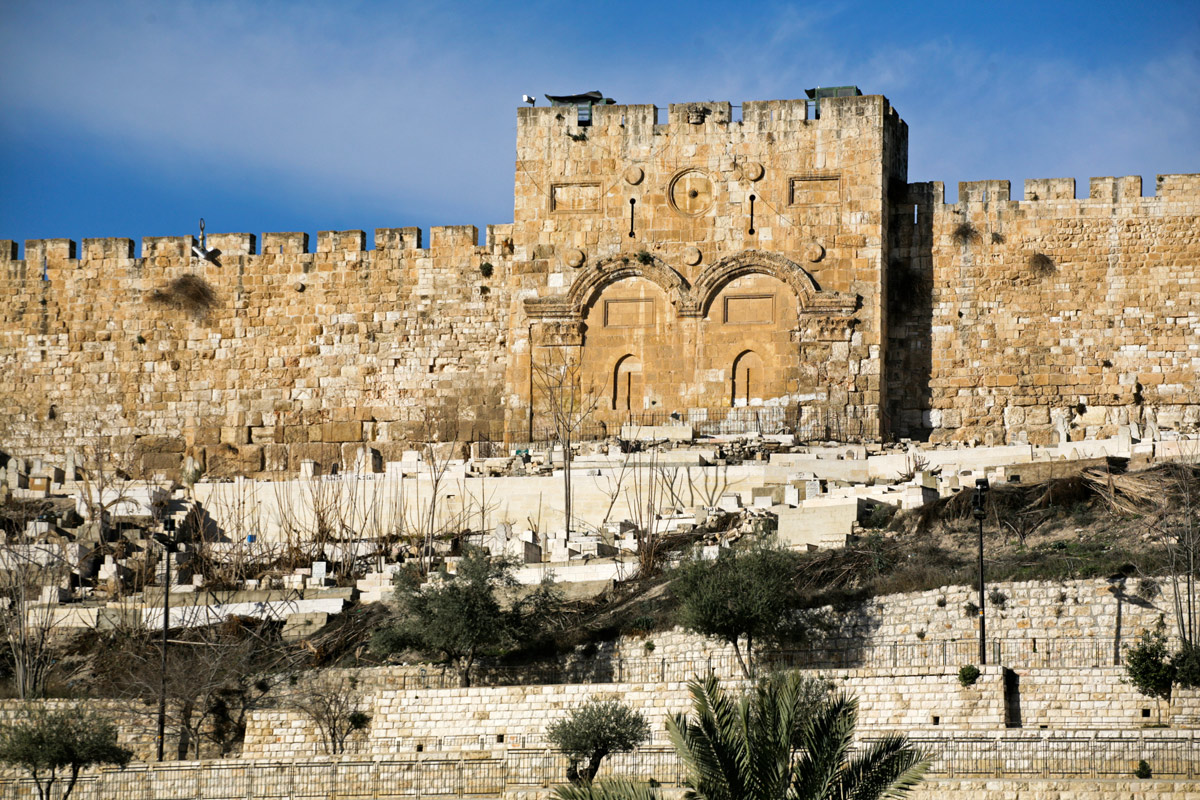
GoldenGate

The East Gate of Jerusalem today

The first man and the first woman had a perfect life. They were free from any problems and would never die. They had a perfect relationship with God, and would personally walk with him in the garden.

Yet they destroyed all of that in their rebellion against God (Genesis 3). Now they faced hard labor, sickness, and death. Their relationship with God was permanently damaged, and they would be forever separated from God.

Their disobedience — their rebellion against God — was their sin. This sin would infect the entire human race through Adam’s descendants, leaving every person separated from God. Humans were no longer capable of having any relationship with God.

But God made a promise to this man and this woman. They would have a descendant who would save the human race from their sin. He would restore their relationship with God.

Over time, God gave more information about the one would save mankind. He was given a title, “The Anointed One”, or in Hebrew, “Messiah”, or in Greek, “Christ”. He would be the sacrifice for sin for the entire world. He would lead his people to freedom and victory. He would rule in peace.  See a more complete list here.

God also gave a specific time for the Messiah. The Messiah would come to Jerusalem on March 29, 33 A.D. [2].

God had given this message about the Messiah to the Jewish people. But as time went on, they were no longer concerned about being saved from their sin. They had devised an elaborate set of rules and laws which gave them confidence that they were were able to personally earn God’s favor. They no longer needed a Messiah to save them from sin.

However, the Jewish nation was often oppressed by other nations. Although they no longer needed (as they believed) a Messiah to save them from sin, they longed for the Messiah to come and free them from their oppressors. They looked forward to the conquering King who would set up a kingdom that would never end.

Then the Messiah came. He came to his own people and his own did not receive him (John 1:11-12). He did not follow the religious laws like he was supposed to, and the religious leaders were jealous of his fame.

Jesus Christ was wildly popular when he was on the earth. He taught like no one else did and he worked spectacular miracles, baffling his enemies and validating his claims to be the Messiah. As his final public act, he caused an explosion in the Jewish religious world by raising Lazarus from the dead (see here).

The hatred of the Jewish leaders was complete. They wanted to cover up the miracle of Lazarus so they determined to kill Jesus. They gave orders everywhere that anyone should report Jesus if they knew where he was (John 11:45-57). Jesus Christ was now a wanted criminal.

Yet as the Passover drew near, it was time for Jesus Christ to enter Jerusalem. It was also time for the city to welcome the Messiah as their king, in fulfillment of the prophecies about him (Daniel 9:24-27). Instead of coming in secret, Jesus came at the head of a massive crowd, cheering him as king.

Why did the crowd welcome Jesus as their King on that day? The miracle of Lazarus had already drawn the interest and the excitement of the people. Jesus had traveled from Galilee to Jerusalem with a large crowd of Passover pilgrims, so they all knew that he was coming. He had spent the Passover (Saturday) in the nearby town of Bethany, so the next opportunity for him to come would be Sunday morning.

Jesus left Bethany with a large crowd of followers on Sunday morning. As He approached the mountain separating him from Jerusalem (the Mount of Olives), he sent two disciples ahead to bring a donkey colt with its mother. The donkey showed his claim as king and fulfilled the prophecy (Zechariah 9:9) that the Messiah would enter on a donkey, the symbol of royalty.

The crowd that accompanied Jesus was met by a larger crowd coming out of Jerusalem. Together, they chanted the Psalm of the Messiah (Psalm 118:24-26), “Hosanna! Blessed is he who comes in the name of The Lord!”

The religious leaders objected to this praise and personally asked Jesus to tell them to stop. But this was the day of Messiah’s coming. If the people did not shout out, the rocks would proclaim him as King!

Through all of this excitement, Luke tells the shocking response by Jesus as he approaches the city. Jesus starts sobbing as the city comes into view. Neither his disciples nor his enemies were able to see through the crowd’s excitement, yet only Jesus saw that these excited people would not receive him. He is given a vision of what will happen to Jerusalem and it brings him to tears. He see the Roman legions surrounding the city, cutting off the supplies and eventually killing the inhabitants. This all happened because they rejected the Messiah.

The people were excited to receive a Messiah of their own design. They wanted a leader to save them from Roman oppression, but they did not want to be saved from their sin. Yet that was His purpose, and that was why He had come. He would be the sacrifice to bring the people back to God.

In less than a week, the same people who were welcoming him as king would be shouting for his death.


Remember!

  • How much do we value a relationship with God? Are we willing to value the sacrifice made by Jesus Christ in order to bring us back to him?
  • As the Messiah, Jesus Christ’s main objective is to free us from sin and bring us back to God. It is as true now as it was in the first century — don’t look for a substitute!
  • The disciples did not understand what was going on until afterward. Don’t miss the important things in life because we are caught up in the moment.


Previous post: Dare to Waste

Categories
encouragement theology

Dare to Waste!

waves-close-up-view-circle-drop-of-water

Jesus had raised Lazarus from the dead (John 11), causing many to believe in him. But this also provoked the anger and jealousy of the chief priests and the Pharisees. They were all united in their plans to kill him (John 11:53).

Jesus had retreated to the town of Ephraim (John 11:54) and stayed there until it was time to come for the Passover. Within a couple weeks of the Passover, He had traveled north from Ephraim through the middle of Samaria and Galilee (Luke 17:11), and joined the bands of Galilean pilgrims as they traveled to Jerusalem [2].

As the crowds neared Jerusalem on Friday, Jesus had split from the group and spent the Sabbath in the nearby town of Bethany. It was there in Bethany that Simon, a healed leper, had hosted a feast for Jesus and his disciples on Saturday night.

During the dinner, Mary shocked the entire crowd. She approached Jesus as he reclined at the table with the dinner guests. She then broke a priceless bottle of perfume and proceeded to pour it on his head. She moved to his feet with the perfume and unbound her hair, using her hair to wipe up the excess from his feet.

The fragrance of this strong perfume permeated the entire house.

Mary’s actions shocked the crowd as she proceeded to anoint his head and wash his feet. But the disciples were deeply scandalized when someone started to add up the cost of the perfume that was wasted on Jesus. Judas lead the disciples in scolding her, saying that this cost over a year’s wage. Why not use that to help the poor?

Jesus’ response to Judas was sharp and abrupt, “Leave her alone!” Her worship of him was more important than even helping the poor.

Mary alone understood that Jesus was coming to die and she was preparing him for his burial. Her story will now forever be joined with the story of the Gospel itself. “She has done a beautiful thing.”

This scene would burn in Judas’ memory. He was still stinging from Jesus’ rebuke three days later when he goes to the chief priests and offers to betray the Lord Jesus Christ.

The other 11 disciples should have known better. They had been following Jesus for the last three and a half years, yet they were so caught up in themselves that they missed what Jesus was trying to teach them.

Mary was the only one who understood what was going on.

This short account opens the final week of Jesus’ ministry on earth. This final week will mark the highest and lowest points of Jesus’ entire days on earth. He will teach his disciples and confront his enemies but there is one primary purpose throughout this week.

He has come to die.


Remember!

  • From the example of Judas, we need to beware lest we become hardened through unbelief. As it says in Hebrews 3:12-13, we need to encourage each other daily!
  • From the example of the 11 disciples, don’t be so caught up in ourselves that we miss what Jesus is saying to us!
  • Finally, from the example of Mary, would we all be so caught up with love for the Lord Jesus Christ that we are ready to lavish our most valuable possessions on him!

Previous post: Greater than Death

Categories
encouragement theology

Greater than Death

Jerusalem Tomb of the Garden

It is a subject that no one wants to talk about, yet it is the one thing that is inevitable for all of us. It is the one constant that unifies every human on earth.

We all will die.

Every culture has its customs and rituals for dealing with death. All of these rituals are ways to show respect for the departed and to comfort the loved ones.

In the ancient Jewish culture, the funeral would last for seven days, with the peak on the fourth day, or “high day” [1] . Friends and neighbors would come to gather around the grieving family and comfort them with loud wailing. The most dedicated friends would help prepare the body for burial by wrapping the body in linen strips and covering it with spices and perfumes. There was no embalming so the body was buried immediately.

The tomb was usually a cave which was built to hold several bodies. After the flesh had fully decomposed, a family member would come in and remove the bones. The entrance to the tomb was covered with a stone in order to keep out thieves and predators, and to protect people from the smell of the decaying body.

At some time during his ministry in Judea (October-December), Jesus had visited Mary and Martha in the small village of Bethany (Luke 10:38-42). He had become very close to the sisters and their brother, Lazarus. After the Feast of Dedication in December, Jesus had crossed the Jordan into Perea, but the sisters were still able to stay in touch with him.

It was now later in the Spring, probably early March, when Mary and Martha send word to Jesus. Lazarus was gravely ill, and they hurriedly dispatch a messenger with the news, “your friend is sick”.

Jesus received the news and announced that this would not end in death. Rather, this event was for the glory of God. Now that he received the news about a close friend who needed him, Jesus waits in Perea for two more days. 

Lazarus had already died by the time the messenger reached Jesus. The point is re-emphasized — He loved Mary and Martha and Lazarus, yet he waits for two more days. There is something greater than restoring Lazarus; there is something greater than comforting the sisters. It is God’s glory.

The religious leaders in Jerusalem had already announced that they wanted to kill Jesus, and Bethany was only two miles from Jerusalem. When Jesus announced his return to Judea, his disciples were concerned for his safety (and their own). Yet Jesus was clear on his intentions: Lazarus was dead and he was going to go raise him.

Jesus arrived in Bethany on the fourth day, the “High Day” of mourning. Lazarus had been buried for four days and a large crowd from Jerusalem had come to console Mary and Martha. Martha met Jesus outside the town and tells him, “Lord, if you had been here, my brother would not have died.” Yet even still, Martha trusts in Jesus. She is prepared that whatever He asks of God, God will give to Him.

“Your brother will rise again”, Jesus tells her. Martha knew about the resurrection of believers, but she still did not understand. Jesus tells her, “I AM the resurrection and the life. Whoever who believes in me, though he is dying, yet he will live.”

Jesus is not just able to restore life. He IS life. Jesus uses the name of God (“I AM”) and declares that he is God and that he is life.

Do you believe this, Martha? Her hope was not on how she felt, it was that she believed in the giver of life.

The next meeting, with Mary, brings Jesus to tears. He will soon bear the weight of the entire world on the cross, yet for now he must bear the grief and heartache of this small town as they stand at the tomb of Lazarus.

Martha objected to Jesus’ command to roll away the stone covering of Lazarus tomb. It had been four days, and the stench would be unbearable. Yet she obeys when Jesus mildly rebukes her and reminds her of the glory of God.

With the stone rolled away, Jesus thanks the Father. The Father has heard his prayer, as he always does, and there will be no doubt that this is from God. Jesus then shouted in his top voice, “LAZARUS, COME OUT!”

I cannot even picture the astonished crowd as Lazarus staggers out of the tomb, still in his linen wrappings. Jesus commands the people to unbind him.

“It is a peculiar thing, you cannot get any instruction in the Bible as to how to conduct a funeral, for Jesus broke up every funeral He ever attended by raising the dead.” – D.L. Moody

It is not surprising that many believed in Jesus that day. Nothing had ever happened like this [8].

But back in Jerusalem, the religious leaders hastily convened a meeting of the Great Sanhedrin. In their minds, this miracle had sparked a national crisis. If more people believe in him, they might get in trouble with Rome.

Therefore, they concluded that they need to contain this belief in Jesus at all costs.

They need to kill him.

It is only a few short weeks before the final Passover, where Jesus will come to Jerusalem and die for the world. Now, everyone is talking about Jesus and his fame is going across the entire country. This miracle has also steeled the resolve of the Jewish leaders. They now are actively looking to kill him.

Jesus heads north to the small town of Ephraim, where he will await the time for one final trip to Jerusalem.


Remember!

  • Jesus breaks everyone’s preconceived notions on how he should behave. He delays when they expect him to hurry, he cries with those grieving, and then he raises the dead! Never underestimate the Lord Jesus Christ!
  • If you have not believed in Him, do not let any more time go by. He is the resurrection. He is the life. If you believe in him, you will live again!
  • Don’t be hardened by avoiding the truth. The Jewish leaders never doubted the miracle, but they loved their sin more than they loved what they knew was the truth!
  • Lean on the truth when you are hurting. Jesus reminded Martha of what she believed.


Previous post: My Sheep Hear my Voice

Categories
encouragement theology

My Sheep Hear My Voice

sunset-7416_1280

Almost three months have passed since Jesus was last in Jerusalem. Since then, Jesus had sent out seventy to preach the gospel, visited the sisters Mary and Martha, and taught many people throughout Judea (Luke 10:1-13:21).

It was now winter (John 10:22) as Jesus returned to Jerusalem for the Feast of Dedication.

The Feast of Dedication, known today as “Hanukkah” takes place in December. It commemorates the time when, in 165 B.C., the faithful Jews were able to rededicate the temple after it had been polluted by the Syrian oppressors.

It is during this time that Jesus is accosted by the Jews. They literally closed in on Jesus demanding that he tell them once and for all: Is he the Messiah?

Jesus had already told them several times, sometimes indirectly (e.g. Luke 4:16-21) and sometimes directly (e.g. John 8:58-59). The Jews had already tried to kill him on many occasions after speaking these words.

The problem was not that they needed more information. They already knew the answer but had decided not to believe.

They did not believe because they were not his sheep. Jesus returned to the pastoral analogy to tell about his true sheep. He has a close, intimate relationship with his own sheep. They hear his voice and they follow him. He knows them.

But at this time, when confronted by people who refused to believe him, Jesus gave some of the most reassuring words to his own sheep:

He gives them eternal life. They will never perish.

They are in his hands, and in the hands of The Father. Nothing will ever take them away from him.

Jesus repeated his oneness with the Father. The people wanted to kill him for daring to speak it, because it was the utmost blasphemy to say that he was God.

Unless he actually was God!

Jesus appealed to the Old Testament scriptures that they all revered. Psalm 82 refers to wicked men as “gods” when they represent God on earth. How much more is it appropriate to say this to one who was actually sent by God!

Furthermore, Jesus’ words already said who he was (see John 5 and John 8). But if they had any reason to doubt his words, his actions showed he was God (see John 5, John 6, and John 9).

The chapter ends with a group of people who do believe. Jesus returned across the Jordan River (to Perea), where people remembered John the Baptist, and that he had announced Jesus as the Messiah. John 10 concludes with saying that many believed in him there.

Even after he was dead, John’s ministry continued to flourish.


Remember! 

  • There are many people who refuse to believe. They don’t need a better argument, they need to come to God.
  • We are promised a close relationship with Jesus Christ and we are promised eternal life. There is NOTHING that will take us away from him! See also Romans 8:35-39.
  • We may never know all of the results when we teach God’s word. John the Baptist never knew how his words would be used long after his death.


Previous Post: The Good Shepherd

Categories
encouragement theology

The Good Shepherd

flock-of-sheep-49666_1280

Psalm 23
The Lord is my shepherd; I shall not want.
He makes me lie down in green pastures.
He leads me beside still waters.
He restores my soul.
He leads me in paths of righteousness
for his name’s sake.
Even though I walk through the valley of the shadow of death,
I will fear no evil,
for you are with me;
your rod and your staff,
they comfort me.
You prepare a table before me
in the presence of my enemies;
you anoint my head with oil;
my cup overflows.
Surely goodness and mercy shall follow me
all the days of my life,
and I shall dwell in the house of the Lord
forever.


The Lord is my shepherd.

How often do we forget that God will guide us, care for us, and protect us?

Jesus Christ takes up the same analogy in his last public sermon. In John 10, he makes two specific statements about himself, showing that he is God, and showing his care for us as sheep.

“I am the door”. Those who enter by Him will be saved and will find safety and satisfaction.

“I am the good shepherd”. He will care for us, to the point that he will lay down his life for us.

The previous chapter (John 9), shows Jesus demonstrating that he is the Messiah by healing a blind man. This stirred up a controversy because he healed the man on the Sabbath. He had healed the blind man, but how could the Messiah break the Sabbath traditions? Jesus used the man’s blindness as an analogy for spiritual blindness. The blind man now believed Jesus and could see. The Pharisees, on the other hand, were blinded by their unbelief.

The scene does not change between John 9 and John 10. Now, in John 10, Jesus points out these same Pharisees who refused to believe. They are not real shepherds of the people, but are instead thieves and robbers, who do not care for the flock.

Jesus then delivers his final public sermon. He recounts three aspects of the life of a shepherd.


Gathering the sheep

First, the shepherd gathers his own sheep from the sheep pen (sheepfold, John 10:1-6). The sheep pen contains several flocks and is guarded by the gatekeeper. The shepherd calls out his own sheep from the multitude, calling them by name. The sheep hear his voice and he leads them out.

The contrast is with the thieves and robbers. They cannot enter through the door and the sheep do not know them.

Just like the shepherd, Jesus will call his disciples out from Israel. He knows each of his own by name and they will know his voice. They will not follow the false leaders.


Sheltering the sheep in the pasture 

Secondly, the shepherd brings the sheep to pasture and guards the doorway to the field shelter (John 10:7-10). The small enclosure at the pastures allows the sheep both protection and shelter from the elements. As the door, the shepherd both admits his own sheep and keeps out predators.

Jesus uses the ancient name of God when he states, “I AM the door of the sheep”. This is the third statement in John’s gospel account where Jesus uses the Old Testament name of God to show who he is (see the complete list here).


Risking his life to protect the sheep

Finally, the shepherd personally puts his own life on the line against dangers in order to protect the sheep (John 10:11-15). It was common in that day for a lion, a bear, or a wolf to attack the flock and attempt to kill any shepherd who may defend the sheep (see 1 Samuel 17:34-35). A hired hand would quickly leave this place of danger, but the shepherd was committed to the sheep, defending them against all possible dangers.

Jesus again uses the ancient name of God when he states (for the fourth time in John’s gospel account), “I AM the good shepherd”. The word for “good” is not just morally right, but also shows excellence and beauty. He is the greatest shepherd.

He also has other sheep outside of this fold (John 10:16). He will gather them together into one flock. Both the Jews and the Gentiles will be united together in the Messiah’s kingdom.

Jesus also promises, as the Good Shepherd, to lay down his life and to take it up again (John 10:17-18). He says four times in this passage that he will lay down his life, and two times that he will take it up again.

In less than 6 months, Jesus will be arrested and killed as a common criminal. Three days later, he will rise again. Don’t miss the point — this is not coming as a surprise! Jesus Christ will die and rise again by his own will.


Remember!

  • Jesus is the Door! He is the way to shelter and protection when you need him. You can go in and out from his shelter and find satisfaction.
  • Jesus is your Good Shepherd! He is the true leader who watches over you and who gave his life for you.
  • Nothing comes as a surprise for Jesus! Even his own death was by his own will.


Previous post: Are you blind?

Categories
encouragement theology

The Truth Will Set You Free

barbed-wire-fence

“The truth will set you free.”

This popular phase has adorned institutes of higher learning and is commonly quoted by intellectuals, and others who value a good education. “When you are exposed to truth, you will be able to throw off the shackles that have enslaved you”; “Only when you learn will you reach your full potential.”

Others use this phrase as encouragement to cleanse yourselves from the trappings of any lies. They see being truthful as freeing yourself from the entanglements caused by your deception, “tell the truth and free yourself”.

But is Jesus really talking about education and self-fulfillment? Look closer at all that Jesus said:

So Jesus said to the Jews who had believed him, “If you abide in my word, you are truly my disciples, and you will know the truth, and the truth will set you free.”

Many believed in Jesus after his last statements. There were also several believers in the crowd from the recent Feast of Tabernacles (see John 7:31). Jesus then turned to the believers. It is not enough to simply agree with the truth about Jesus. To be a true disciple of Jesus, you need to abide in his word. 

What does it mean to abide in his word? The word for “abide” is meno (μένω), which means to take up residence; to continue; remain; not depart. It means to stay connected to His word. Jesus uses the same word, “abide”, in John 15 when he compared his disciples as branches to a vine. We abide in Him when we stay connected to him. We need to make his word our source, our guide, our refuge, and our comfort.

What is the truth? Jesus made it clear that the freedom is from sin, yet the people already believed that they were free. Part of the truth is to shatter their false security so that they may know that they need to be rescued from sin. But Jesus, himself, is the truth (John 14:6). All who believe in him will be rescued from sin (John 3:14-18).

What happens to the true disciples who abide in His word? They will know the truth that makes them free. The true disciples will know the truth about freedom from sin and receive eternal life with God.

“By nature far from Him, they were bondsmen. Only if they abode in His Word would they know the truth, and the truth would make them free. The result of this knowledge would be moral, and hence that knowledge consisted not in merely believing on Him, but in making His Word and teaching their dwelling – abiding in it.” – Alfred Edersheim [3]

In the previous study on John 8, we had covered that Jesus commanded the listeners to “Follow Me” four times in this chapter. Each time he repeated the command, he made the command more specific and had increasingly hostile responses. In each of these four commands, Jesus also gave a promise for those who follow him:

  • “Follow Me” (John 8:12-20)
  • “Believe that I AM” (John 8:21-30)
  • “Abide in my word” (John 8:31-47)
  • “Keep my word” (John 8:48-59)

The final two commands, discussed here, are both related to Jesus’ Word. What makes the difference between a true disciple and an unbeliever? Their response to His Word.


“Abide in my word”

It is those who abide in His Word that are his true disciples. The promise, discussed above, is that the true disciples would know Jesus and be made free from sin.

But the opposition to Jesus has increased severely. The Jews did not believe that they need anything else other than to be a descendant of Abraham. They would rather kill Jesus than face the truth. They dismissed Jesus as an illegitimate child, who is not worthy of teaching them.

The response by Jesus was the strongest yet. There are only two families: the family of God and the family of The Devil. If they do not love the one sent by God, then they are children of The Devil! How are they identified as children of The Devil? Because they do not love Jesus and they cannot bear to hear his word.


“Keep my word” 

“Truly, truly, I say to you, if anyone keeps my word, he will never see death.”

Jesus also gives the promise that those who keep his word will never see death. Their bodies may die but they will never be separated from God (See Revelation 21:1-8).

“Now outwardly, of course, believers die as others die. And yet the wonderful thing is that the words of Jesus are absolutely true: the believer does not see death. What does he see? He sees the entrance into the Father’s house. Death, we are told, is our servant. How does death serve us? By ushering us into the presence of God.” – H.A. Ironside [4]

The opposition by the Jews goes beyond the personal attacks. They now accused Jesus of being demon-possessed. The response by Jesus was the promise here, but he also relied on the glory from God the Father.

The Jews were shocked that Jesus may claim to be a greater man than Abraham, yet that was not what Jesus was saying. He was not a greater man than Abraham. He was the God of Abraham!


Remember!

Things to remember from this study:

  • Jesus is the truth. If you want to be free, know Jesus! To be free from your sin, get closer to Jesus Christ.
  • There are only two families: the family of God and the family of the Devil.
  • Get close to Jesus by abiding in His Word!


Previous post: Light of the World

Categories
encouragement theology

Light of the World

fire-in-the-sky

I try to picture the scene as if I were there in person. The Feast of Tabernacles, one of the biggest celebrations on the Jewish calendar, has been going on for the past week. Jewish people from all over the world have come to Jerusalem to live in temporary shelters and celebrate this occasion.

The Feast of Tabernacles was a time for the Jewish people to remember their ancestors when they wandered in the wilderness (see more details here). The ceremony of water commemorated God’s miraculous provision of water throughout the years of desert wanderings. This feast also looked forward to the Kingdom of the Messiah, when God would again personally lead his people and provide for their needs.

But the Feast of Tabernacles also celebrated the light of the Messiah. God had personally led their ancestors through the desert in a cloud by day and a fire by night. Four giant candelabra in the temple courts (more like giant torches) were lit during the feast, illuminating the entire city of Jerusalem.

But now the feast had ended and people were preparing to leave. The four giant candelabra — no longer burning —  stood as silent reminders of the great celebration. As the people look on, Jesus walks by these great candelabra and speaks to the crowd,

“I am the light of the world.”

 But he does not stop there:

“Whoever follows me will not walk in darkness, but will have the light of life.”

To roughly translate this, He was saying, “These giant torches that you see are now finished. But I am the real light and I will never go out. Follow me and I will give you light and I will give you life.”

Jesus also uses the Hebrew name of God, “I AM”. He actually refers to himself as “I AM” several times in this passage:

  • “I AM the light of the world”
  • “Unless you believe that I AM you will die in your sins”
  • “When you have lifted up the Son of Man, then you will know that I AM”

This chapter is very direct, very specific, and very confrontational. Jesus gives the command to “Follow Me” four times in this chapter (John 8). Each time he repeats the command, he makes it more specific and he receives increasingly hostile responses. In each of these four commands, Jesus also gives a motivation for following him:

  • “Follow Me” (John 8:12-20)
  • “Believe that I AM” (John 8:21-30)
  • “Abide in my word” (John 8:31-47)
  • “Keep my word” (John 8:48-59)

We go through the first two commands in this study and will cover the second two commands in the next study.


“Follow Me”

In the statement above, Jesus said that he is the light of the world. Jesus is the God that the Jews claim to worship, and he offers the light of life to all who follow him. The Pharisees interjected with, “Who are you to speak like that?” Jesus responded that he was sent by God the Father, and they do not know the Father if they do not know him.


Believe that I AM”

Again, Jesus referred to himself as the Hebrew name of God, “I AM”. This time he was very direct to the people: “Unless you believe that I AM” you will die in your sins. You can either believe Jesus or reject him. But if you refuse to believe Jesus you will face an eternity separated from God. The people reply with, “Who do you think you are?” Jesus responded that he speaks the truth that was given to him from the Father who sent him. When they see the Son of Man lifted up (on the cross), then they will know that “I AM”.


Remember!

Things to remember from this study:

  • If you are waiting to believe in Jesus, you are running out of time! He is the light of the world who will give you life. But if you refuse to believe, you will die separated from God.
  • If you do believe in Jesus, follow him! Let Him be your counselor, your guide, and your illumination.
  • Jesus always appealed to the Father in these times of conflict. You have a higher authority and you are not alone!


Previous Post: Don’t Waste Your Life!

Categories
encouragement theology

Don’t waste your life!

Guilt…

Punishment…

Forgiveness…

Restoration

This short drama is inserted in the middle of Jesus’ discourses during the Feast of Tabernacles. Many scholars debate where this story belongs, or if it should even be in the Bible at all [1].

This story is also beloved by many people in our culture, many who may not know much more about Jesus. It is popular to compare people today with either the guilty woman or the accusing Pharisees. Most of these comparisons are made in ways to make the storyteller look good. But very few people who tell this story realize who this story is really about.

It is about Jesus.

 Jesus came down from the Mount of Olives where he had spent the night on the open ground. He came to the temple and began teaching the people about the the Kingdom of God. As was often the case, his teaching was interrupted by a real-life application.

A commotion in the crowd stops his teaching. Out of that commotion comes a gang of Pharisees and their scribes, dragging a woman with them. They set the woman in front of Jesus and announce that she has been caught in adultery. They remind Jesus that the law of Moses commands that she be stoned to death, but what does he say? 

The Pharisees laid a trap for Jesus. God is just, and if Jesus declares God’s Justice, then she must be stoned. This would break the Roman law and destroy Jesus’ reputation for compassion.

But God is also merciful. If Jesus declares God’s mercy, then she would go free. But for Jesus to do so would break the law of Moses and destroy Jesus claims to be the Messiah.

How do you reconcile God’s justice and his mercy?

Jesus reconciled this for woman in the same way that he reconciles his justice and mercy for you and I. She sinned. She broke God’s law. She was guilty. The punishment was death.

Someone would die.

The accusers would not find the justice they were seeking. It took Jesus to only remind them of their own sin for them to walk away, one by one. They did not press the charges, but they also did not ask for forgiveness. The simply walked away. The entire crowd left.

Many people like to end the story with the accusers leaving, but they miss the woman’s restoration. Jesus never skipped over her sins. Instead, he left her with a command, “Go and sin no more”.

“You are restored, now stop wasting your life.” 

It will be less than six months away that Jesus will pay for this woman’s sin. He will also pay for your sin and for my sin. He will pay for the sins of the whole world. 

Stop wasting your life!


Previous post: If Anyone is Thirsty

Categories
encouragement theology

How do you respond to crisis?

How do you respond in times of crisis?

In the next scene in John’s gospel account, we see both Jesus and his disciples at a time of crisis. It is often at these times, when we are at our limits, that we find out what we have and what we truly need.

For Jesus, this was a critical turning point in his ministry.  He has spent the last two and a half years presenting himself to the nation of Israel, showing that he is their king.  Jesus had spent the entire day teaching and healing a huge crowd of over 20,000 people, and now they want to make him a king by force. The people like what he has to say and are interested in his miracles, but they refuse to submit to him as Lord. Jesus will spend his remaining year preparing both his disciples and himself for his upcoming sacrifice. 

The disciples must have been filled with shock and dismay. They had returned from their own teaching tours of Galilee and personally witnessed Jesus feeding this massive crowd. Everyone loved Jesus and the disciples were sure that he was now going to rule as their king. But instead, Jesus abruptly sends them away and dismisses the crowd. Now they are on their own, alone on the lake, rowing toward the other shore.

Jesus spends the night alone in prayer with the Father. He draws his heart close to the Father as he deals with his disappointment over the crowd that would not believe. He is close to the Father as he considers his upcoming rejection, death, and coming back to life.

As Jesus is praying on the mountain, he looks over the wide expanse of the lake below him. There, out on the lake, are his disciples in the boat, struggling against the wind. The wind picks up as the night goes on, and his disciples row harder. Jesus sees them struggle as he continues to pray.

After 9 hours, Jesus ends his time of prayer and walks out to his disciples on the water. It is now past 3:00am and they have been rowing all night. The disciples see him walking to them on the water and panic. It must have been a very unnatural sight to see Jesus walking over the waves to them. Through their disappointment and exhaustion of that day, they could only believe that this was a ghost.

Jesus calls out to them and joins them in the boat. Immediately, the waves are calm and they are at their destination. The astounded disciples are now ready to worship him as God. For as long as they had been with Jesus, and as much as they had seen, they still had not believed in him as God.

They did not understand about the loaves, but their hearts were hardened. Even in the presence of his great miracle, his own disciples were reluctant to believe in him as God. It is not enough to believe good things about Jesus, they needed to accept him as God.

Both Jesus and his disciples were in a time of crisis, but in the end the answer was the same.  They needed to lean on God during their time of peril. Jesus spent time with God first, and then went out to his struggling followers. The disciples tried to fight the wind on their own and completely missed the presence of the Lord with them.


Previous post: How do you handle interruptions?  

Categories
encouragement theology

How do you handle interruptions?

What do you do when your plans are destroyed? How do you react when your day is thrown into chaos?

How do we handle it when God sends an opportunity in the form of a major interruption?

I have been studying the life of Jesus Christ, trying to understand more about his life and his ministry. The recent study in John 5 demonstrates that Jesus was fully God.  He was fully equal to God the Father in his works, in giving life, and in authority. There are no secrets between the Father and the Son.

But Jesus was also fully human. He did not exercise his divine power unless he was directed by the Spirit. Jesus had to grow and learn. He got tired. He felt pain, hunger, and loneliness like the rest of us.

Jesus would also make plans which would get interrupted. One of the best examples of this interruption comes in the beginning of John 6.

Jesus has had an extensive ministry in Galilee for about a year and a half.  He has led his disciples, taught the people, and healed many.  His popularity has grown rapidly, to the point that he often cannot even enter towns because of the crowds that follow him.

But along with his popularity, the opposition to Jesus has also grown dramatically.  The Pharisees in the synagogues were not pleased when Jesus challenged their rules about the Sabbath.  As shown in John 5, their anger further turns to murderous rage when Jesus tells them that he is God. Their unbelief has become so entrenched that they interpret Jesus’ miracles as a work of Satan (Matthew 12:22-32, Mark 3:22-30).

And so Jesus’ ministry in Galilee comes to a close.  Jesus has gone across Galilee proclaiming that he is the Messiah.  He even sent out his disciples to make sure that every town and village has heard.  His popularity continues to grow, but so does the opposition and unbelief.  And now the word reaches Jesus that John the Baptist has been murdered by King Herod, who is now looking for him.  Added to his opposition is now political intrigue.

One of the final events of Jesus’ northern ministry happens on the shores of the Sea of Galilee, yet what is most striking is how much of this event is unplanned.  Jesus takes his disciples away to a desolate place, away from the opposition and intrigue, so that they can get some time of rest and teaching.

But as is often the case, plans are interrupted by providence. A huge crowd of over 20,000 people followed them on foot and were waiting for them as they dock the boat [6].  Jesus saw the crowd and responded with compassion. These people were lost and needed a shepherd, and so he taught them and healed the sick.

 Jesus spends the entire day among the people until the evening (about 3:00 pm), when he is interrupted by the disciples.  It is getting close to dinner time and no one had brought provisions.  Jesus instructs the disciples to not stop the teaching, and adds, “you give them something to eat”.  Going further, he asks Philip where they could buy enough bread for these people. Philip responds with their hopeless situation.  Even if they could come up with 8 months salary, they still would not even have a single bite for everyone!

Andrew located one boy who had brought five barley loaves and two small fish, but what are they for such a crowd? Jesus had the disciples sit everyone down while he took the loaves, gave thanks, and broke them.  He then began to distribute the broken pieces until everyone had as much as they wanted.  The disciples gathered up the leftovers, filling up 12 bushel baskets!

There was no mistaking this miracle.  A crowd of over 20,000 people had witnessed and took part in the miracle.  The crowd’s reaction also confirms the miracle, “This is indeed the Prophet who is to come into the world!” (John 6:14).

This is a very well known Bible story.  Many Sunday School lessons are about the “story of the five loaves and the two fish”.  Other than the Resurrection, this is the only other miracle described in all four Gospel accounts.  It is easy to become so familiar with the story that we miss what is happening, but here are a couple important points to remember:

  • This account is not about a boy who was willing to give his lunch away.  Nor is this account (directly) about any one of Jesus’ disciples, including Philip and Andrew.  This is about Jesus.  This is written so that may know that Jesus is the Messiah, and that by believing we may have life in his name (John 20:30-31). 
  • Jesus is still God, even when there is an interruption, and even when there is a crisis.  God is not surprised by interruptions. 
  • Jesus instructed his disciples, “You give them something to eat”.  He provided the food but they were to be the ones to give it to the people. [5]


Previous post: Jesus says that he is God

Categories
adoption encouragement marriage and family

Countless Blessings

Oh come, let us sing to the LORD;
let us make a joyful noise to the rock of our salvation!
Let us come into his presence with thanksgiving;
let us make a joyful noise to him with songs of praise!
For the LORD is a great God,
and a great King above all gods.
Psalm 95:1-3

It’s official! The six children we set out out to adopt earlier this year are our children … … at least in Latvia.  God provided the way and has been with us every step.  He has more than answered our prayers, blessing us abundantly.

USA

I’ve intended for months to write a “thank you” post regarding God’s overwhelming love the past several months, particularly as expressed through his people.  Life has been a bit hectic, however, the past five months, but in a very good way.

After many months of paperwork, interviews, and more paperwork, we have one more trip (our third) back to Latvia to process U.S. immigration for the children to be admitted as citizens.  We spent most the month of August in Latvia for our “first” hearing (which actually entails two formal court hearings, two informal meetings with the adoption judge and an interview at the U.S. embassy).  Like the children’s visit last Christmas, Inga, the then-orphanage director, was with us every step of the way.  She attended every hearing and spent nearly every day with us.  Inga prepared a (large) rental home for us and reserved a large van with a full time professional driver (required for passenger vehicles in excess of 9). She also brought us several home made and excruciatingly delicious Latvian tortes.  She taught us how to make eastern-European styled pork roasts. Inga planned an itinerary and showed us the sights of Latvia from well known Cesis castle to Rundale Palace to off-the-beaten-path places like Barefoot Walk , the delicious bread of Liepkalni bakery (the best rye bread I’ve ever had), Viking boat tour of the Dauguva, a fantastical doll museum in Preili and the nearby ruins of Kokneses castle and several other interesting places. IMG_2173Perhaps my sweetest surprise was the afternoon we spent with master beekeeper Jana Bisu, eating honey directly from a few of his hundreds of hives.

We returned to the loving embrace of dozens of our friends and families at the airport.  As I mentioned on these pages before, it was a celebration of life and a lifetime memory.  It has been the only time I’ve walked into an airport terminal to the sound of vuvuzelas blaring and people cheering — and for us! We were embarrassed and encouraged and loved.  Our Latvian children were primarily bewildered.  All were exhausted after 24 hours of travel.  It was a welcome home kiss from God.

A week after we returned, several members of our church coordinated a clothing and stuff donation drive.  There was so much donated that donations not only filled one room – they filled several.  There was the ‘girl sweater’, the ‘boy pants room’ etc.  The kids’ favorites were the toy room and the sports room.  Within minutes they were riding scooters and bikes up and down the church hallway.  We were encouraged to select as many items as we wanted.  Unwanted items were sold at a local thrift store for which we received a gift card.  Following our ‘shopping’ spree they treated us to a reception/celebration.  Many friends and family participated and we felt so loved and encouraged.

IMG_1778IMG_1825IMG_1818

Another great example of support we received came through our daughter’s American Heritage Girls troup. The coordinator approached us saying they wanted to bless us with their annual service project.  Together we came up with the idea of doing a ‘yard make-over’ to prepare our home to put up for sale.  The outside had been at the bottom of the priority list with basic survival as a large family at the top of the list for several months so the yard was definitely in need of some TLC.  By 9am that day mini vans lined our street and whole families marched about our lawn armed with rakes and shovels.  Dead leaves were removed; flowers were planted; and 20 cubic yards of mulch was spread.  The transformation was incredible and trumped only by the support we felt.

The love we’ve received has been incredible, very welcomed and appreciated. Through the past year, so many friends and people we do not know have prayed for us and/or given us encouragement, time, money, food, clothes, toys, furniture, bicycles, bedsheets, computers, games, puzzles, medicine, dental care, yard cleaning, house cleaning, packing/moving/unpacking help, and I’m sure there are at least another dozen areas of help we received.  It has been an overwhelming wave of love.  There are too many names to name.  To each and every one – THANK YOU!

thank you

A few folks commented that we are “saints” for adopting six children at once.  Heh. They are correct in the theologically accurate, New Testament sense that we are “saints” because we have placed our faith in Jesus Christ as our lord and savior.  In the colloquial sense, however, I can assure you that I don’t feel “saintly.”  What we experience is just what every other parent experiences, it’s just we’re getting a more concentrated dose of it lately.  Parenting and marriage exercise the fruits of faith.  Or to put it less diplomatically, few things expose our fallen, self-centered nature more readily than parenting and marriage.  At least that’s the case for me.  Being an adoptive father of a large set has shown me more areas than I care to admit where I really need to be more like Christ and less like me.  “Areas” … that’s too generous.  More like territories.  Like Newfoundland size territories.

But while being stretched over the past year exposed my weaknesses, God yet again showed me that He is far bigger than my shortcomings.  He provided beyond my weaknesses and beyond our expectations.  He is a mighty and awesome God who provides for his children.  We might not feel saintly, but we feel incredibly blessed.  We serve a holy and almighty God. He provided the way and loved all twelve of us abundantly, particularly through His people – the church.  We thank God for each of you who faithfully loved and supported us this past year.

God is great!

IMG_2721